The Sun
The Sun is a yellow dwarf star (G2V), about 4.6 billion years old, and the dominant gravitational force in the Solar System. It has a diameter of roughly 1.4 million kilometers and contains around 99.8% of the Solar System’s mass. Nuclear fusion in its core converts hydrogen into helium, producing energy that warms the planets. Above the core lie the radiative and convective zones, followed by the visible photosphere (~5,500 °C), the chromosphere, and the much hotter corona (~2 million °C).
Source: science.nasa.gov
APODs including "The Sun"
Planets Over Egyptian Pyramid
04/05/2022
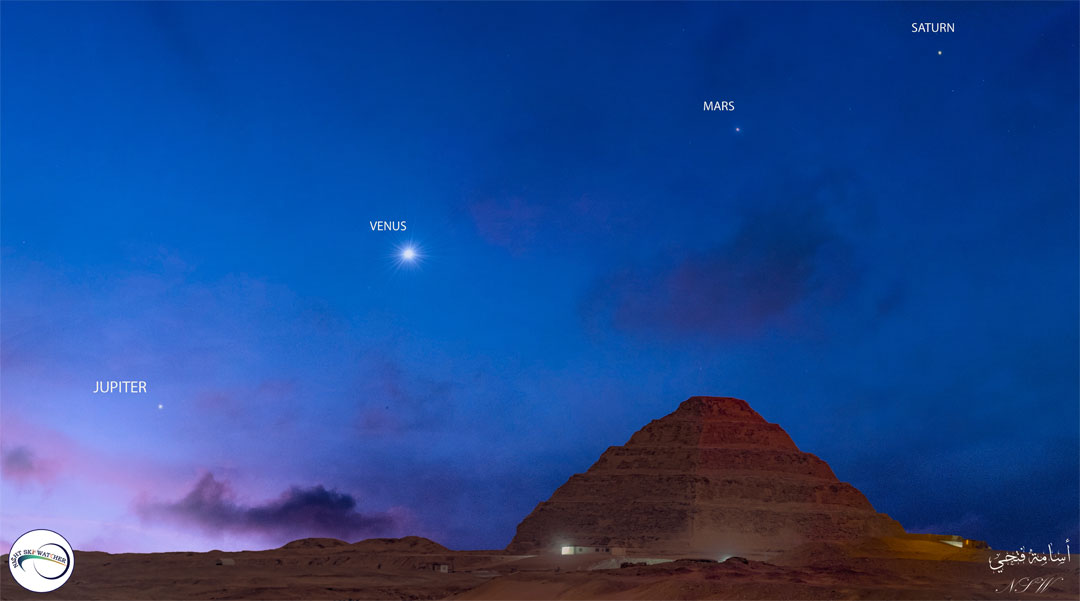
The early morning planet parade continues. Visible the world over, the planets Jupiter, Venus, Mars and Saturn have been lining up in the pre-dawn sky since mid-April. In the featured image taken last month, these planets were captured over the Step Pyramid of Djoser, a UNESCO World Heritage Site. Located in the Saqqara necropolis of Egypt, the pyramid was constructed in the 27th century BC and is one of the oldest pyramids known. The two-image composite includes a foreground image taken during evening blue hour, and a background image captured from the same location the following morning. The morning planet line-up is slowly changing. At the end of last month, planets Jupiter and Venus switched places, while at the end of this month, Jupiter and Mars will switch after passing within one-degree of each other. Of course, this picturesque planetary angular alignment is a coincidence, as all of these worlds continue to orbit the Sun as they have for billions of years, well before even the ancient Pyramid of Djoser was built. Notable Submissions to APOD: Morning Planet Parade 2022