The Sun
The Sun is a yellow dwarf star (G2V), about 4.6 billion years old, and the dominant gravitational force in the Solar System. It has a diameter of roughly 1.4 million kilometers and contains around 99.8% of the Solar System’s mass. Nuclear fusion in its core converts hydrogen into helium, producing energy that warms the planets. Above the core lie the radiative and convective zones, followed by the visible photosphere (~5,500 °C), the chromosphere, and the much hotter corona (~2 million °C).
Source: science.nasa.gov
APODs including "The Sun"
Red Crepuscular Rays from an Eclipse
30/05/2022
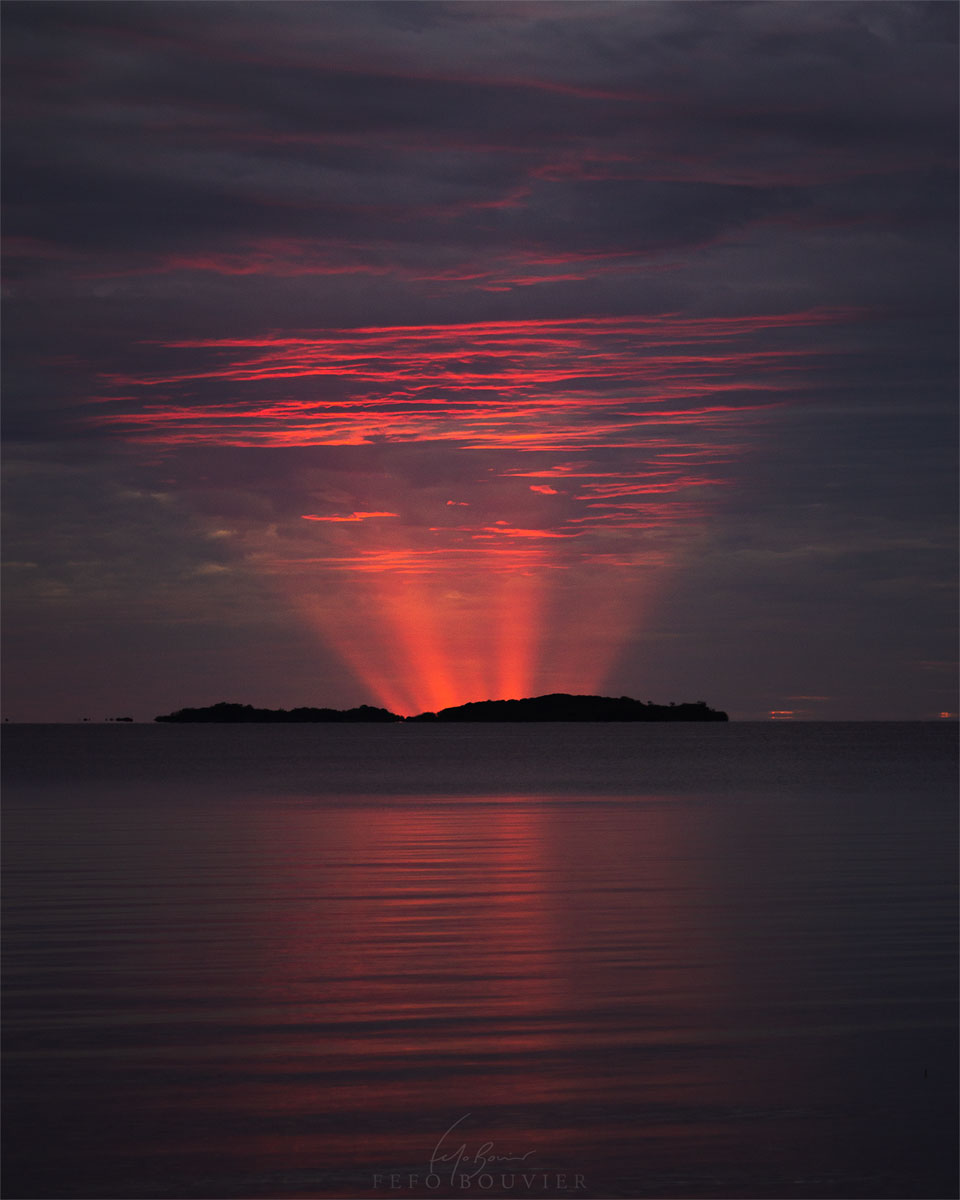
What's happening behind that island? Things both expected and unexpected. Expected, perhaps, the pictured rays of light -- called crepuscular rays -- originate from the Sun. Unexpected, though, the Sun was being partially eclipsed by the Moon at the time -- late last month. Expected, perhaps, the Sun's rays are quite bright as they shine through gaps in below-horizon clouds. Unexpected, though, the crepuscular rays are quite red, likely the result an abundance of aerosols in Earth's atmosphere scattering away much of the blue light. Expected, with hope, a memorable scene featuring both the Moon and the Sun, superposed. Unfortunately, from this location -- in Uruguay looking toward Argentina -- clouds obscured the eclipse -- which wasn't completely unexpected. However, after packing up to go home, the beauty of bright red crepuscular rays emerged -- quite unexpectedly. Oh -- and that island on the horizon -- it's really two islands.