The Sun
The Sun is a yellow dwarf star (G2V), about 4.6 billion years old, and the dominant gravitational force in the Solar System. It has a diameter of roughly 1.4 million kilometers and contains around 99.8% of the Solar System’s mass. Nuclear fusion in its core converts hydrogen into helium, producing energy that warms the planets. Above the core lie the radiative and convective zones, followed by the visible photosphere (~5,500 °C), the chromosphere, and the much hotter corona (~2 million °C).
Source: science.nasa.gov
APODs including "The Sun"
Solar System Family Portrait
29/06/2022
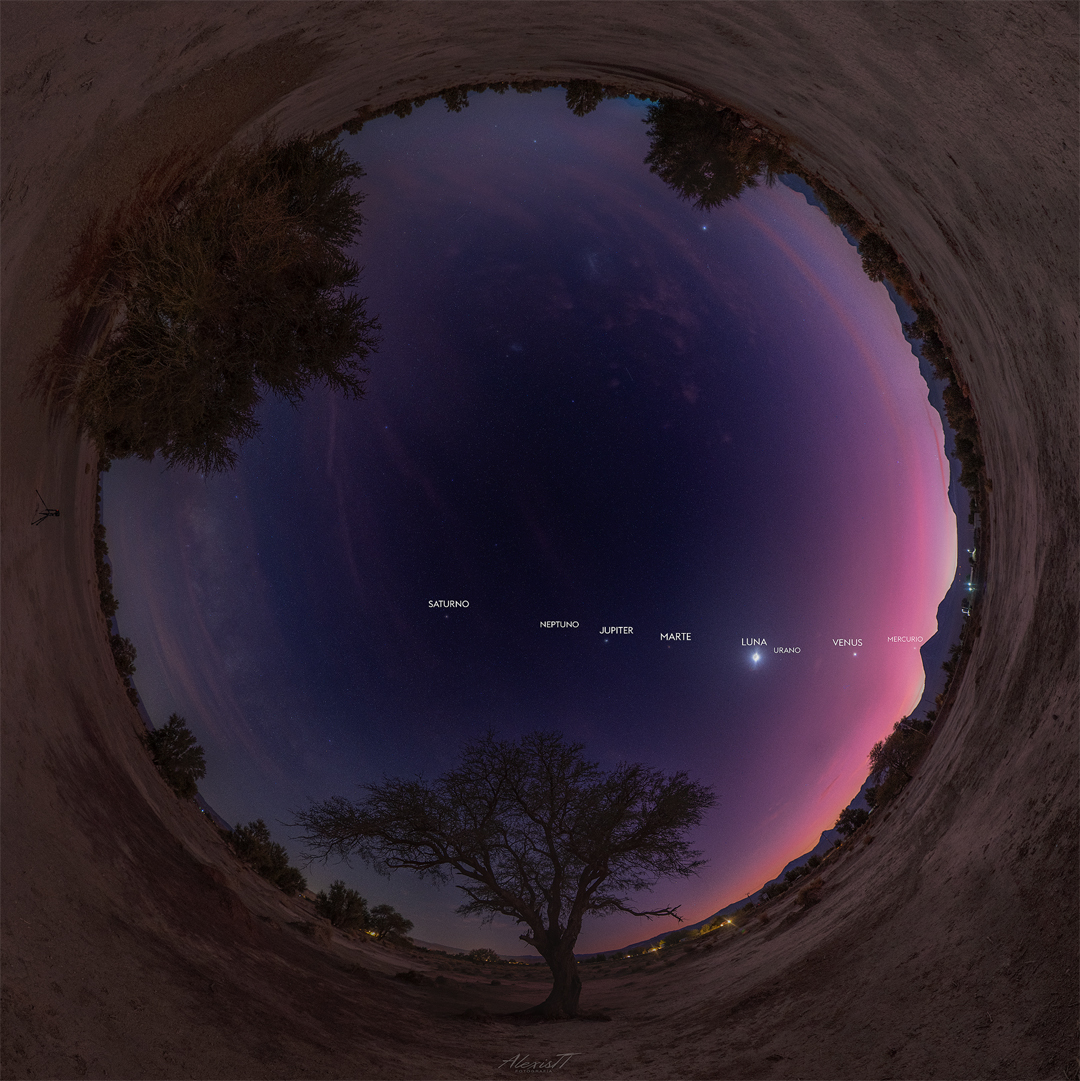
Yes, but have you ever seen all of the planets at once? A rare roll-call of planets has been occurring in the morning sky for much of June. The featured fisheye all-sky image, taken a few mornings ago near the town of San Pedro de Atacama in Chile, caught not only the entire planet parade, but the Moon between Mars and Venus. In order, left to right along the ecliptic plane, members of this Solar System family portrait are Earth, Saturn, Neptune, Jupiter, Mars, Uranus, Venus, Mercury, and Earth. To emphasize their locations, Neptune and Uranus have been artificially enhanced. The volcano just below Mercury is Licancabur. In July, Mercury will move into the Sun's glare but reappear a few days later on the evening side. Then, in August, Saturn will drift past the direction opposite the Sun and so become visible at dusk instead of dawn. The next time that all eight planets will be simultaneously visible in the evening sky will be in 2122. Notable Submissions to APOD: Morning Planet Parade 2022 June