The Sun
The Sun is a yellow dwarf star (G2V), about 4.6 billion years old, and the dominant gravitational force in the Solar System. It has a diameter of roughly 1.4 million kilometers and contains around 99.8% of the Solar System’s mass. Nuclear fusion in its core converts hydrogen into helium, producing energy that warms the planets. Above the core lie the radiative and convective zones, followed by the visible photosphere (~5,500 °C), the chromosphere, and the much hotter corona (~2 million °C).
Source: science.nasa.gov
APODs including "The Sun"
September Sunrise Shadows
24/09/2022
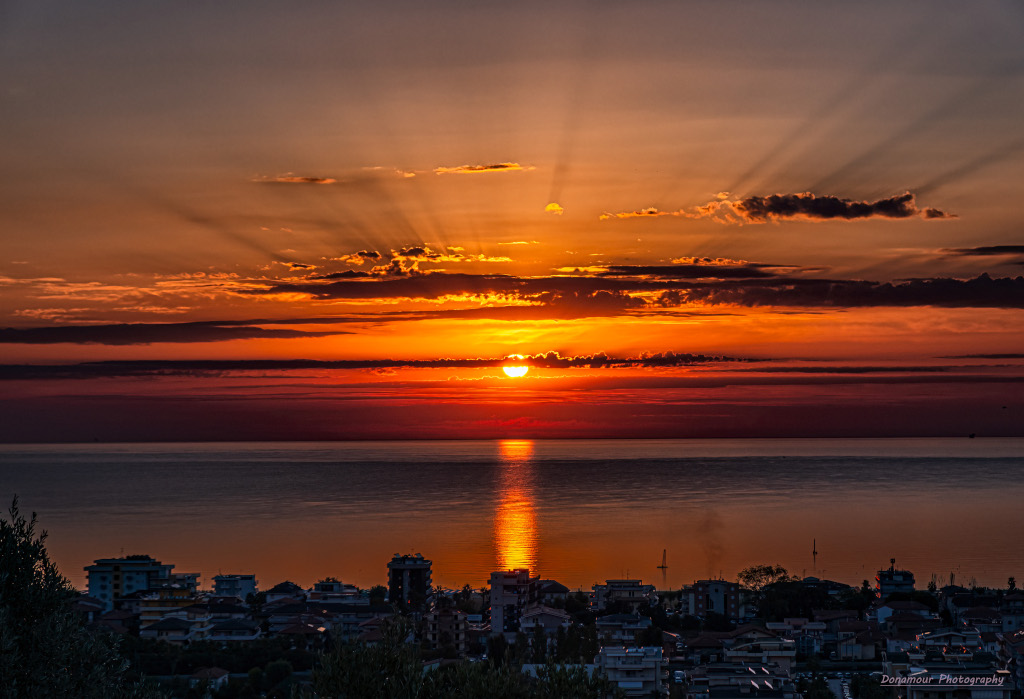
The defining astronomical moment for this September's equinox was on Friday, September 23, 2022 at 01:03 UTC, when the Sun crossed the celestial equator moving south in its yearly journey through planet Earth's sky. That marked the beginning of fall for our fair planet in the northern hemisphere and spring in the southern hemisphere, when day and night are nearly equal around the globe. Of course, if you celebrate the astronomical change of seasons by watching a sunrise you can also look for crepuscular rays. The shadows cast by clouds can have a dramatic appearance in the twilight sky during any sunrise or sunset. Due to perspective, the parallel shadows will seem to point back to the rising Sun and a place due east on your horizon near the equinox date. Taken on September 15, this sunrise sea and skyscape captured crepuscular rays in the sky and watery specular reflections from the Mediterranean coast near the village of Petacciato, Italy.