The Sun
The Sun is a yellow dwarf star (G2V), about 4.6 billion years old, and the dominant gravitational force in the Solar System. It has a diameter of roughly 1.4 million kilometers and contains around 99.8% of the Solar System’s mass. Nuclear fusion in its core converts hydrogen into helium, producing energy that warms the planets. Above the core lie the radiative and convective zones, followed by the visible photosphere (~5,500 °C), the chromosphere, and the much hotter corona (~2 million °C).
Source: science.nasa.gov
APODs including "The Sun"
In Ganymede's Shadow
07/10/2022
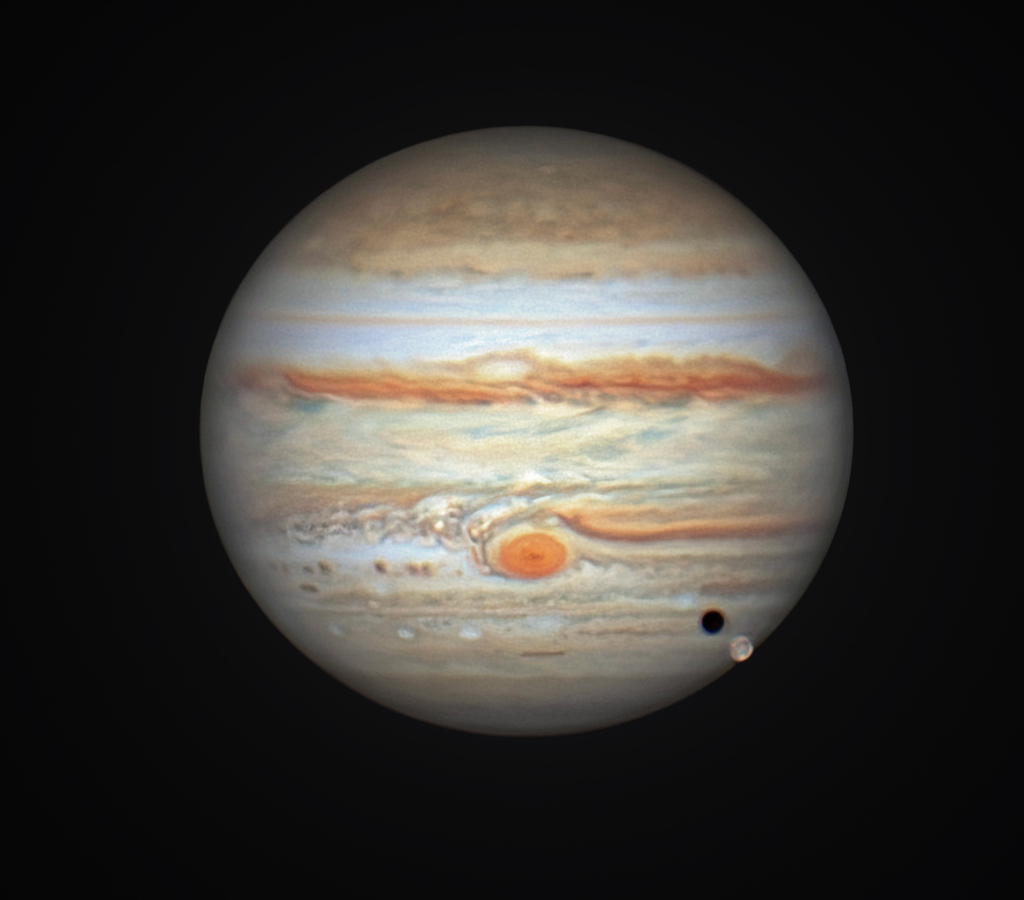
At opposition, opposite the Sun in Earth's sky, late last month Jupiter is also approaching perihelion, the closest point to the Sun in its elliptical orbit, early next year. That makes Jupiter exceptionally close to our fair planet, currently resulting in excellent views of the Solar System's ruling gas giant. On September 27, this sharp image of Jupiter was recorded with a small telescope from a backyard in Florence, Arizona. The stacked video frames reveal the massive world bounded by planet girdling winds. Dark belts and light zones span the gas giant, along with rotating oval storms and its signature Great Red Spot. Galilean moon Ganymede is below and right in the frame. The Solar System's largest moon and its shadow are in transit across the southern Jovian cloud tops.