The Sun
The Sun is a yellow dwarf star (G2V), about 4.6 billion years old, and the dominant gravitational force in the Solar System. It has a diameter of roughly 1.4 million kilometers and contains around 99.8% of the Solar System’s mass. Nuclear fusion in its core converts hydrogen into helium, producing energy that warms the planets. Above the core lie the radiative and convective zones, followed by the visible photosphere (~5,500 °C), the chromosphere, and the much hotter corona (~2 million °C).
Source: science.nasa.gov
APODs including "The Sun"
A Double Lunar Analemma over Turkey
10/10/2022
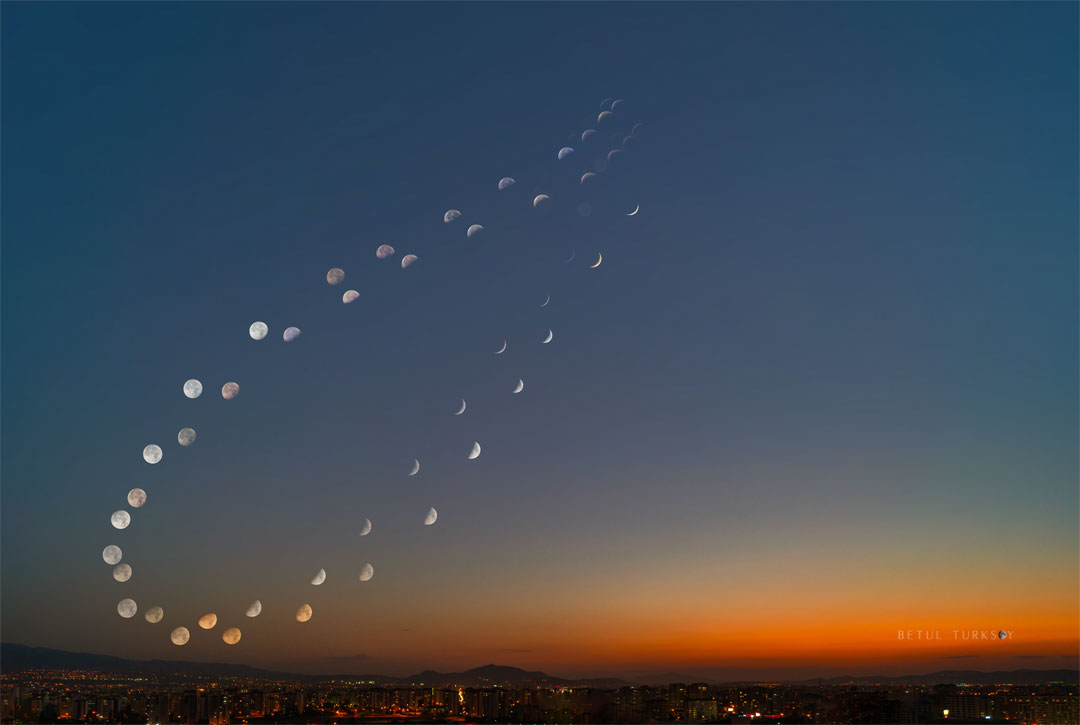
An analemma is that figure-8 curve you get when you mark the position of the Sun at the same time each day for one year. But the trick to imaging an analemma of the Moon is to wait bit longer. On average the Moon returns to the same position in the sky about 50 minutes and 29 seconds later each day. So photograph the Moon 50 minutes 29 seconds later on successive days. Over one lunation or lunar month it will trace out an analemma-like curve as the Moon's actual position wanders due to its tilted and elliptical orbit. Since the featured image was taken over two months, it actually shows a double lunar analemma. Crescent lunar phases too thin and faint to capture around the New moon are missing. The two months the persistent astrophotographer chose were during a good stretch of weather during July and August, and the location was Kayseri, Turkey