The Sun
The Sun is a yellow dwarf star (G2V), about 4.6 billion years old, and the dominant gravitational force in the Solar System. It has a diameter of roughly 1.4 million kilometers and contains around 99.8% of the Solar System’s mass. Nuclear fusion in its core converts hydrogen into helium, producing energy that warms the planets. Above the core lie the radiative and convective zones, followed by the visible photosphere (~5,500 °C), the chromosphere, and the much hotter corona (~2 million °C).
Source: science.nasa.gov
APODs including "The Sun"
Stereo Mars near Opposition
03/12/2022
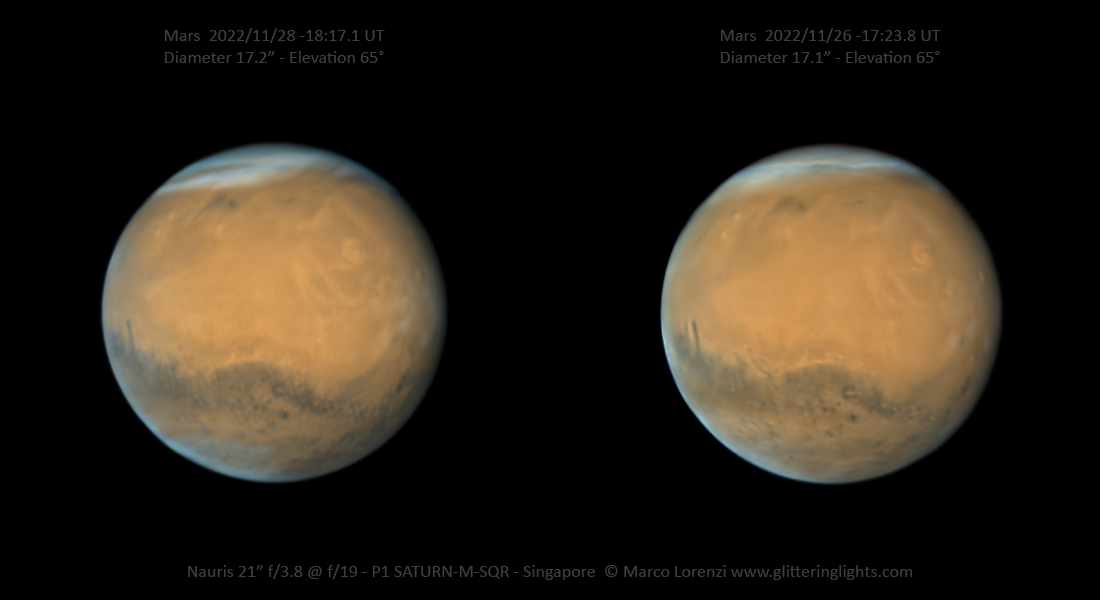
Mars looks sharp in these two rooftop telescope views captured in late November from Singapore, planet Earth. At the time, Mars was about 82 million kilometers from Singapore and approaching its opposition, opposite the Sun in planet Earth's sky on December 8. Olympus Mons, largest of the volcanoes in the Tharsis Montes region (and largest known volcano in the Solar System), is near Mars' western limb. In both images it's the whitish donut-shape at the upper right. The dark area visible near center is the Terra Sirenum region while the long dark peninsula closest to the planet's eastern limb is Sinus Gomer. Near its tip is Gale crater, the Curiosity rover's landing site in 2012. Above Sinus Gomer, white spots are other volcanoes in the Elysium region. At the top of the planet is the north polar cap covered with ice and clouds. Taken about two days apart, these images of the same martian hemisphere form a stereo pair. Look at the center of the frame and cross your eyes until the separate images come together to see the Red Planet in 3D.