The Sun
The Sun is a yellow dwarf star (G2V), about 4.6 billion years old, and the dominant gravitational force in the Solar System. It has a diameter of roughly 1.4 million kilometers and contains around 99.8% of the Solar System’s mass. Nuclear fusion in its core converts hydrogen into helium, producing energy that warms the planets. Above the core lie the radiative and convective zones, followed by the visible photosphere (~5,500 °C), the chromosphere, and the much hotter corona (~2 million °C).
Source: science.nasa.gov
APODs including "The Sun"
A Full Circle Rainbow over Norway
27/12/2022
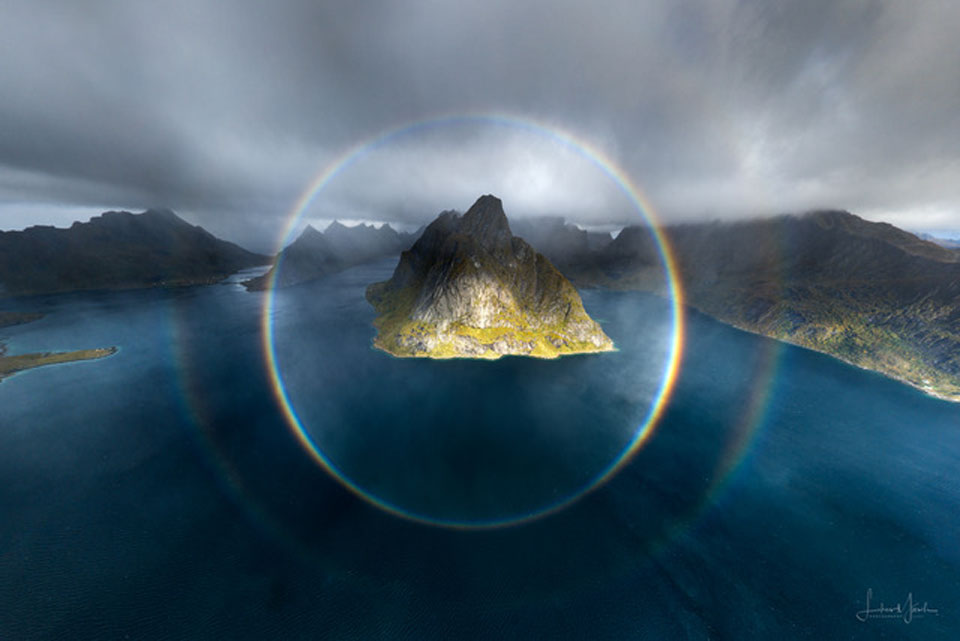
Have you ever seen an entire rainbow? From the ground, typically, only the top portion of a rainbow is visible because directions toward the ground have fewer raindrops. From the air, though, the entire 360-degree circle of a rainbow is more commonly visible. Pictured here, a full-circle rainbow was captured over the Lofoten Islands of Norway in September by a drone passing through a rain shower. An observer-dependent phenomenon primarily caused by the internal reflection of sunlight by raindrops, the rainbow has a full diameter of 84 degrees. The Sun is in the exact opposite direction from the rainbow's center. As a bonus, a second rainbow that was more faint and color-reversed was visible outside the first.