The Sun
The Sun is a yellow dwarf star (G2V), about 4.6 billion years old, and the dominant gravitational force in the Solar System. It has a diameter of roughly 1.4 million kilometers and contains around 99.8% of the Solar System’s mass. Nuclear fusion in its core converts hydrogen into helium, producing energy that warms the planets. Above the core lie the radiative and convective zones, followed by the visible photosphere (~5,500 °C), the chromosphere, and the much hotter corona (~2 million °C).
Source: science.nasa.gov
APODs including "The Sun"
Moon over Makemake
31/12/2022
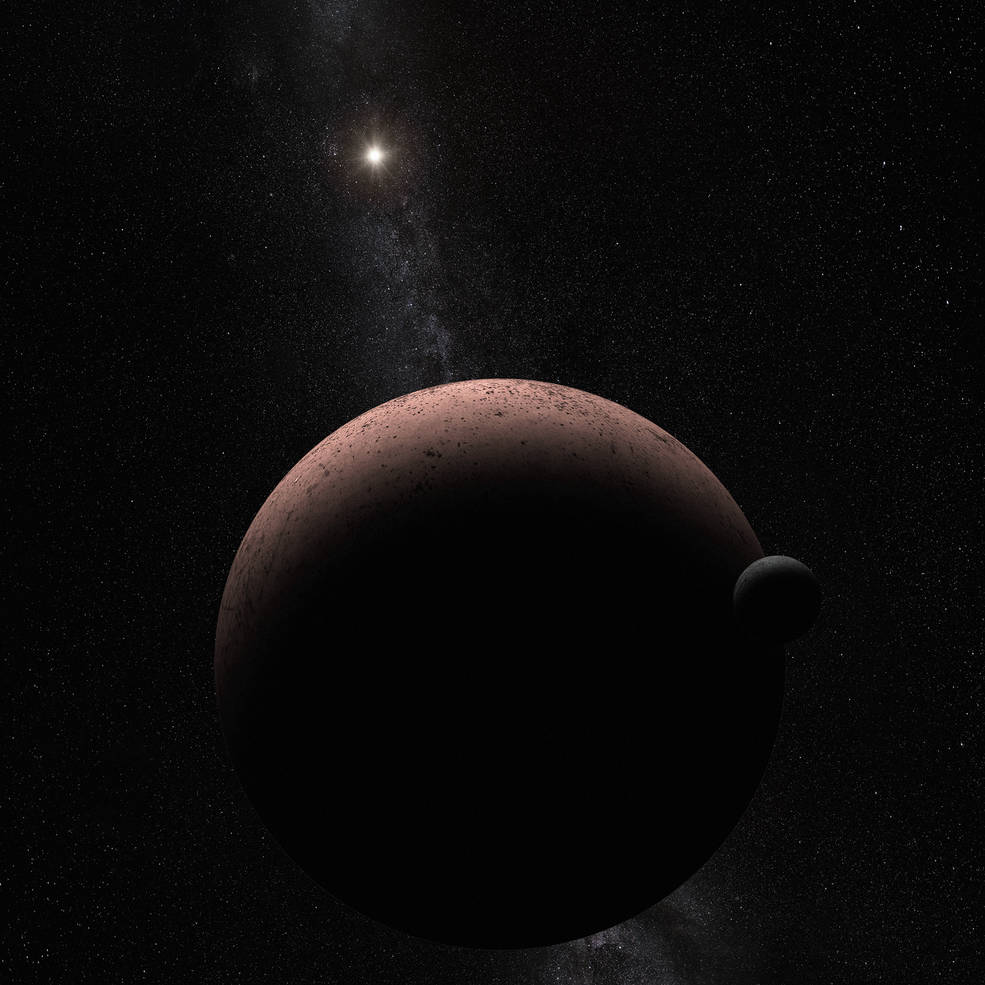
Makemake (sounds like MAH-kay MAH-kay), second brightest dwarf planet of the Kuiper belt, has a moon. Nicknamed MK2, Makemake's moon reflects sunlight with a charcoal-dark surface, about 1,300 times fainter than its parent body. Still, in 2016 it was spotted in Hubble Space Telescope observations intended to search for faint companions with the same technique used to find the small satellites of Pluto. Just as for Pluto and its satellites, further observations of Makemake and orbiting moon will measure the system's mass and density and allow a broader understanding of the distant worlds. About 160 kilometers (100 miles) across compared to Makemake's 1,400 kilometer diameter, MK2's relative size and contrast are shown in this artist's vision. An imagined scene of an unexplored frontier of the Solar System, it looks back from a spacecraft's vantage as the dim Sun shines along the Milky Way. Of course, the Sun is over 50 times farther from Makemake than it is from planet Earth.