The Sun
The Sun is a yellow dwarf star (G2V), about 4.6 billion years old, and the dominant gravitational force in the Solar System. It has a diameter of roughly 1.4 million kilometers and contains around 99.8% of the Solar System’s mass. Nuclear fusion in its core converts hydrogen into helium, producing energy that warms the planets. Above the core lie the radiative and convective zones, followed by the visible photosphere (~5,500 °C), the chromosphere, and the much hotter corona (~2 million °C).
Source: science.nasa.gov
APODs including "The Sun"
Moon O'Clock 2022
06/01/2023
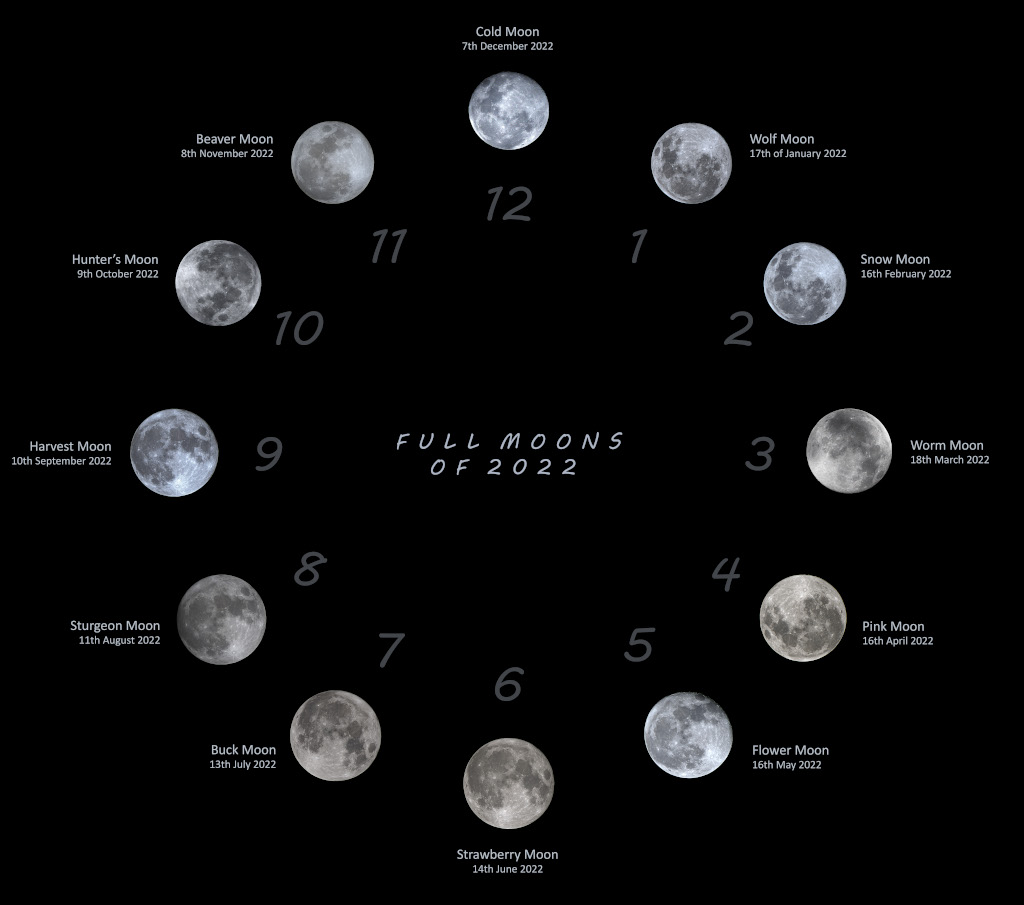
The first Full Moon of 2023 is in the sky tonight opposite the Sun at 23:08 UTC. Big and beautiful, the Moon at its brightest phase should be easy to spot. Still, for quick reference images captured near the times of all the full moons of 2022 are aranged in this dedicated astro-imaging project from Sri Lanka, planet Earth. The day, month, and a traditional popular name for 2022's twelve full moons are given in the chart. The apparent size of each full moon depends on how close the full lunar phase is to perigee or apogee, the closest or farthest point in the Moon's elliptical orbit. Like the 2022 Wolf Moon at the 1 o'clock position, tonight's Full Moon occurs within about two days of apogee. But unlike in 2022, the year 2023 will have 13 full moons that won't all fit nicely on the twelve hour clock.