The Sun
The Sun is a yellow dwarf star (G2V), about 4.6 billion years old, and the dominant gravitational force in the Solar System. It has a diameter of roughly 1.4 million kilometers and contains around 99.8% of the Solar System’s mass. Nuclear fusion in its core converts hydrogen into helium, producing energy that warms the planets. Above the core lie the radiative and convective zones, followed by the visible photosphere (~5,500 °C), the chromosphere, and the much hotter corona (~2 million °C).
Source: science.nasa.gov
APODs including "The Sun"
Perihelion Sun 2023
14/01/2023
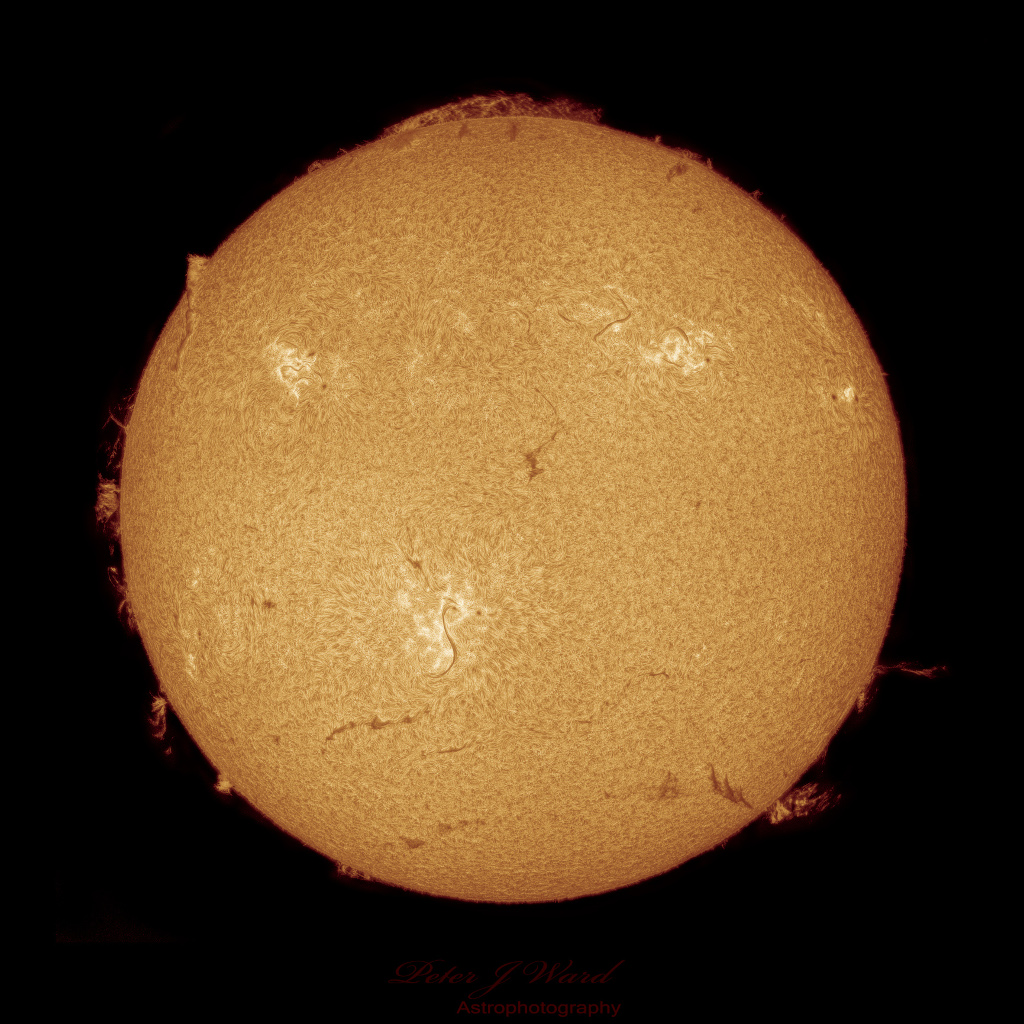
Perihelion for 2023, Earth's closest approach to the Sun, was on January 4 at 16:17 UTC. That was less than 24 hours after this sharp image of the Sun's disk was recorded with telescope and H-alpha filter from Sydney, Australia, planet Earth. An H-alpha filter transmits a characteristic red light from hydrogen atoms. In views of the Sun it emphasizes the Sun's chromosphere, a region just above the solar photosphere or normally visible solar surface. In this H-alpha image of the increasingly active Sun planet-sized sunspot regions are dominated by bright splotches called plages. Dark filaments of plasma snaking across the solar disk transition to bright prominences when seen above the solar limb.