The Sun
The Sun is a yellow dwarf star (G2V), about 4.6 billion years old, and the dominant gravitational force in the Solar System. It has a diameter of roughly 1.4 million kilometers and contains around 99.8% of the Solar System’s mass. Nuclear fusion in its core converts hydrogen into helium, producing energy that warms the planets. Above the core lie the radiative and convective zones, followed by the visible photosphere (~5,500 °C), the chromosphere, and the much hotter corona (~2 million °C).
Source: science.nasa.gov
APODs including "The Sun"
Naked-eye Comet ZTF
21/01/2023
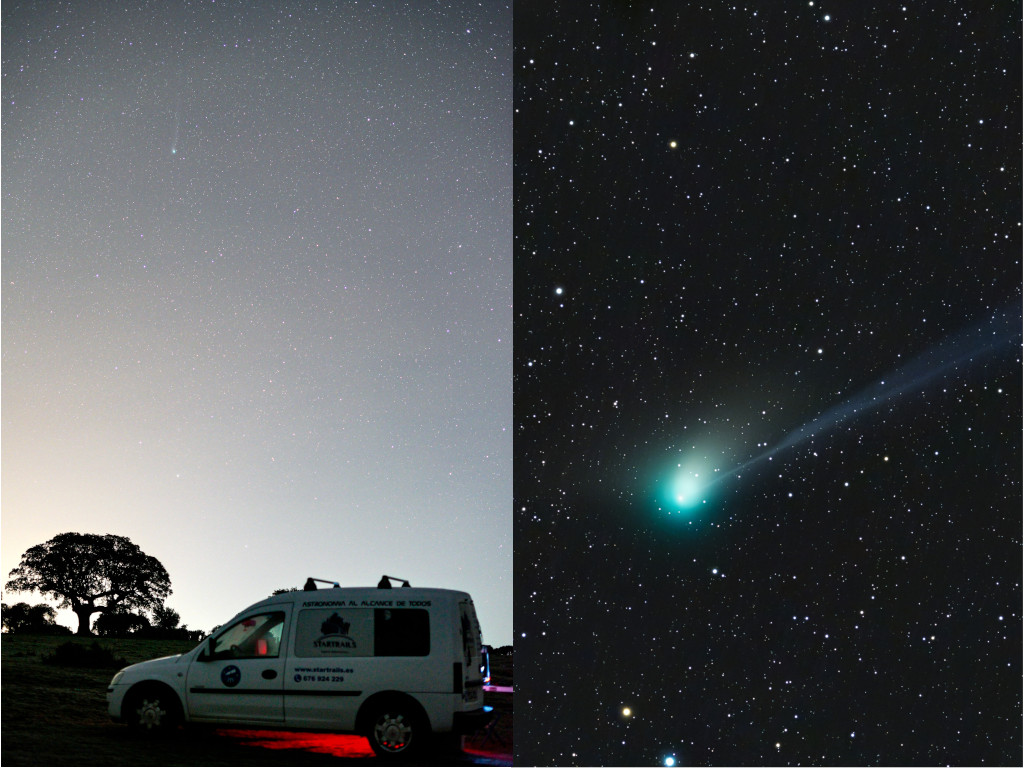
Comet C/2022E3 (ZTF) no longer requires a telescope for viewing. By January 19, it could just be seen with the naked eye in this rural sky with little light pollution from a location about 20 kilometers from Salamanca, Spain. Still, telescopic images are needed to show any hint of the comet's pretty green coma, stubby whitish dust tail, and long ion tail. Its faint ion tail has been buffeted by recent solar activity. This visitor from the distant Oort cloud rounded the Sun on January 12. and is now sweeping through stars near the northern boundary of the constellation Bootes. Outward bound but still growing brighter, Comet ZTF makes its closest approach on February 2, coming to within about 2.4 light-minutes of our fair planet.