The Sun
The Sun is a yellow dwarf star (G2V), about 4.6 billion years old, and the dominant gravitational force in the Solar System. It has a diameter of roughly 1.4 million kilometers and contains around 99.8% of the Solar System’s mass. Nuclear fusion in its core converts hydrogen into helium, producing energy that warms the planets. Above the core lie the radiative and convective zones, followed by the visible photosphere (~5,500 °C), the chromosphere, and the much hotter corona (~2 million °C).
Source: science.nasa.gov
APODs including "The Sun"
Comet ZTF: Orbital Plane Crossing
27/01/2023
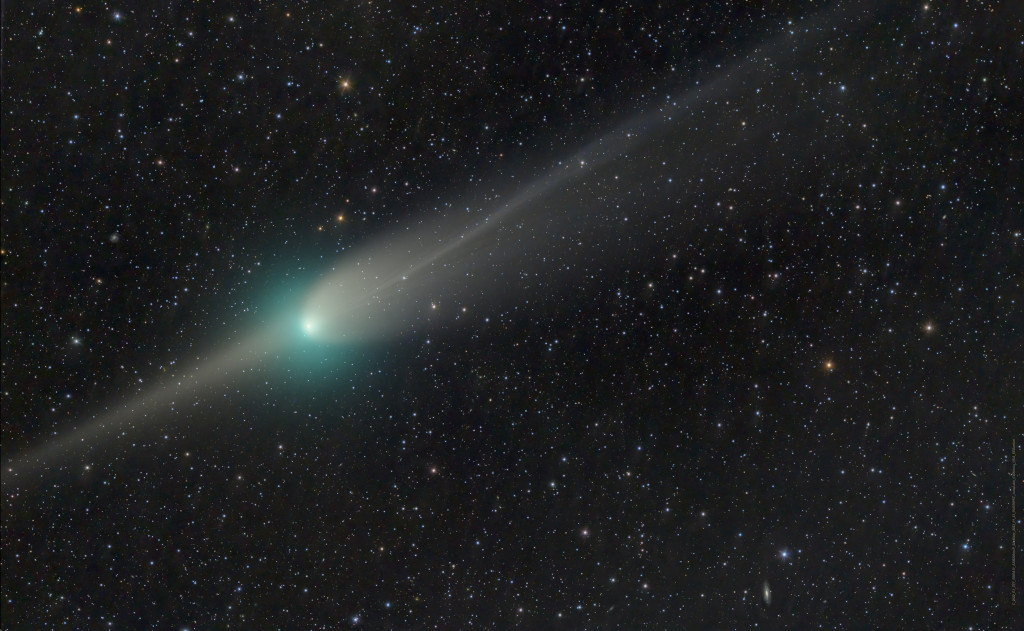
The current darling of the northern night, Comet C/2022 E3 ZTF is captured in this telescopic image from a dark sky location at June Lake, California, USA. Of course Comet ZTF has been growing brighter in recent days, headed for its closest approach to Earth on February 1. But this view was recorded on January 23, very close to the time planet Earth crossed the orbital plane of long-period Comet ZTF. The comet's broad, whitish dust tail is still curved and fanned out away from the Sun as Comet ZTF sweeps along its orbit. Due to perspective near the orbital plane crossing, components of the fanned out dust tail appear on both sides of the comet's green tinted coma though, to lend Comet ZTF a visually striking (left) anti-tail. Buffeted by solar activity the comet's narrower ion tail also streams away from the coma diagonally to the right, across the nearly three degree wide field of view. Comet ZTF Gallery: Notable Submissions to APOD