The Sun
The Sun is a yellow dwarf star (G2V), about 4.6 billion years old, and the dominant gravitational force in the Solar System. It has a diameter of roughly 1.4 million kilometers and contains around 99.8% of the Solar System’s mass. Nuclear fusion in its core converts hydrogen into helium, producing energy that warms the planets. Above the core lie the radiative and convective zones, followed by the visible photosphere (~5,500 °C), the chromosphere, and the much hotter corona (~2 million °C).
Source: science.nasa.gov
APODs including "The Sun"
A Comet and Two Dippers
07/02/2023
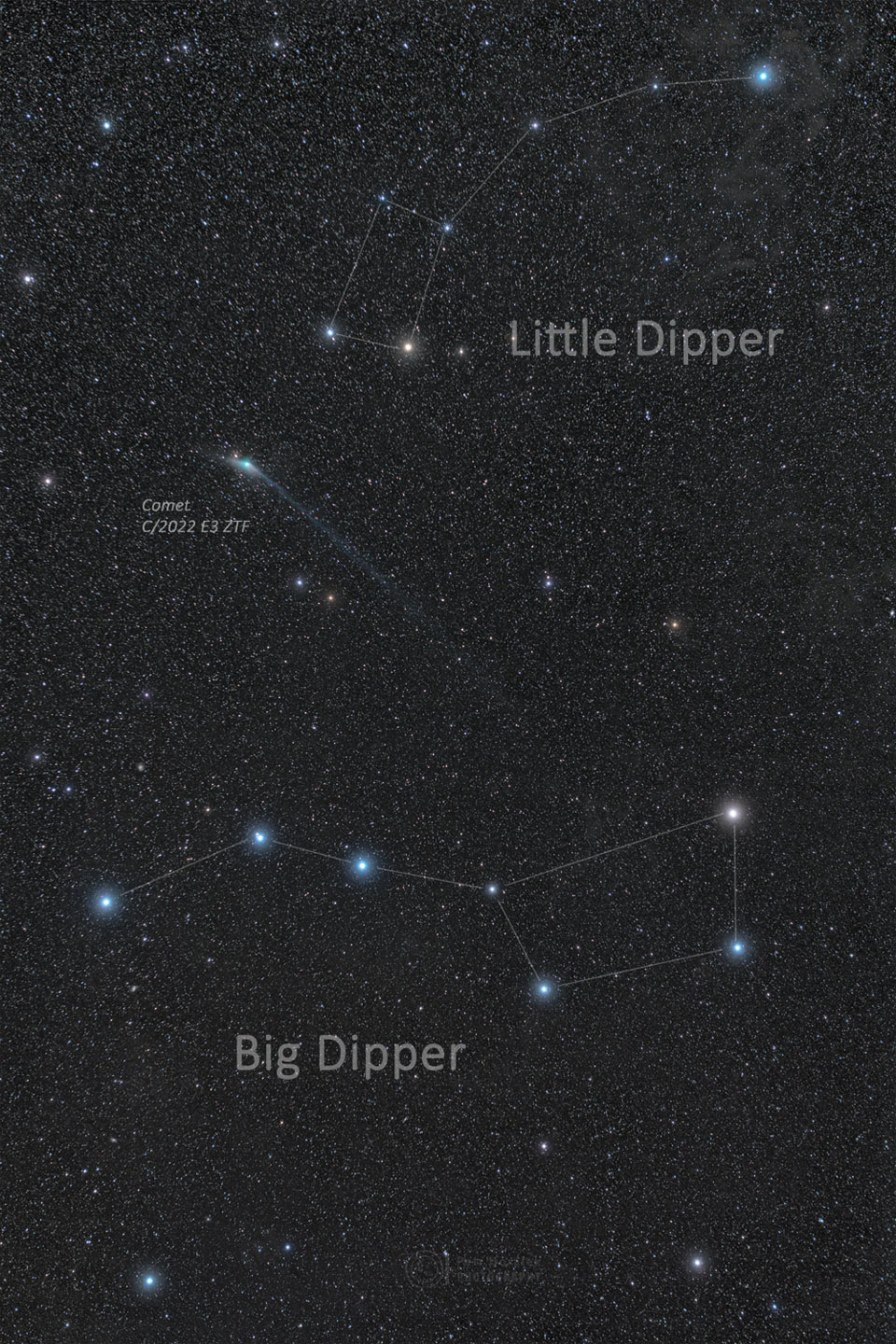
Can you still see the comet? Yes. Even as C/2022 E3 (ZTF) fades, there is still time to see it if you know where and when to look. Geometrically, Comet ZTF has passed its closest to both the Sun and the Earth and is now headed back to the outer Solar System. Its orbit around the Sun has it gliding across the northern sky all month, after passing near Polaris and both the Big and Little Dippers last month. Pictured, Comet ZTF was photographed between the two dippers in late January while sporting an ion tail that extended over 10 degrees. Now below naked-eye visibility, Comet ZTF can be found with binoculars or a small telescope and a good sky map. A good time to see the comet over the next week is after the Sun sets -- but before the Moon rises. The comet will move nearly in front of Mars in a few days Comet ZTF Gallery: Notable Submissions to APOD