The Sun
The Sun is a yellow dwarf star (G2V), about 4.6 billion years old, and the dominant gravitational force in the Solar System. It has a diameter of roughly 1.4 million kilometers and contains around 99.8% of the Solar System’s mass. Nuclear fusion in its core converts hydrogen into helium, producing energy that warms the planets. Above the core lie the radiative and convective zones, followed by the visible photosphere (~5,500 °C), the chromosphere, and the much hotter corona (~2 million °C).
Source: science.nasa.gov
APODs including "The Sun"
Comet ZTF over Yosemite Falls
21/02/2023
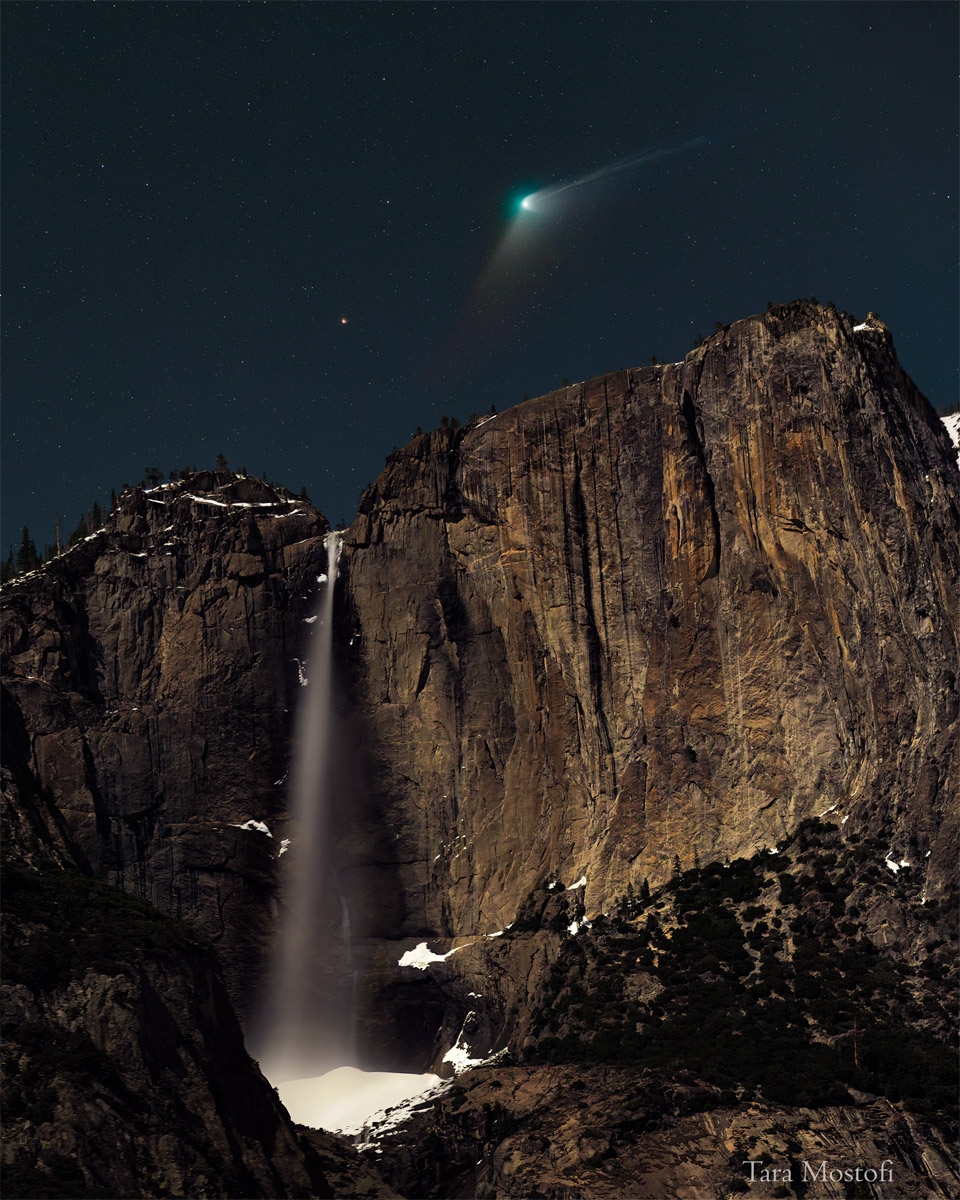
They are both falling. The water in Yosemite Falls, California, USA, is falling toward the Earth. Comet ZTF is falling toward the Sun. This double cosmic cascade was captured late last month as fading Comet C/2022 E3 (ZTF) had just passed its closest to planet Earth. The orange star just over the falls is Kochab. With the exception of a brief encounter with a black bear, the featured image was a well-planned composite of a moonlit-foreground and long-duration background exposures - all designed to reconstruct a deep version of an actual single sight. Although Comet ZTF is now fading as it glides back to the outer Solar System, its path is determined by gravity and so it can be considered to still be falling toward the Sun -- but backwards. Comet ZTF Gallery: Notable Submissions to APOD