The Sun
The Sun is a yellow dwarf star (G2V), about 4.6 billion years old, and the dominant gravitational force in the Solar System. It has a diameter of roughly 1.4 million kilometers and contains around 99.8% of the Solar System’s mass. Nuclear fusion in its core converts hydrogen into helium, producing energy that warms the planets. Above the core lie the radiative and convective zones, followed by the visible photosphere (~5,500 °C), the chromosphere, and the much hotter corona (~2 million °C).
Source: science.nasa.gov
APODs including "The Sun"
Zodiacal Ray with Venus and Jupiter
27/02/2023
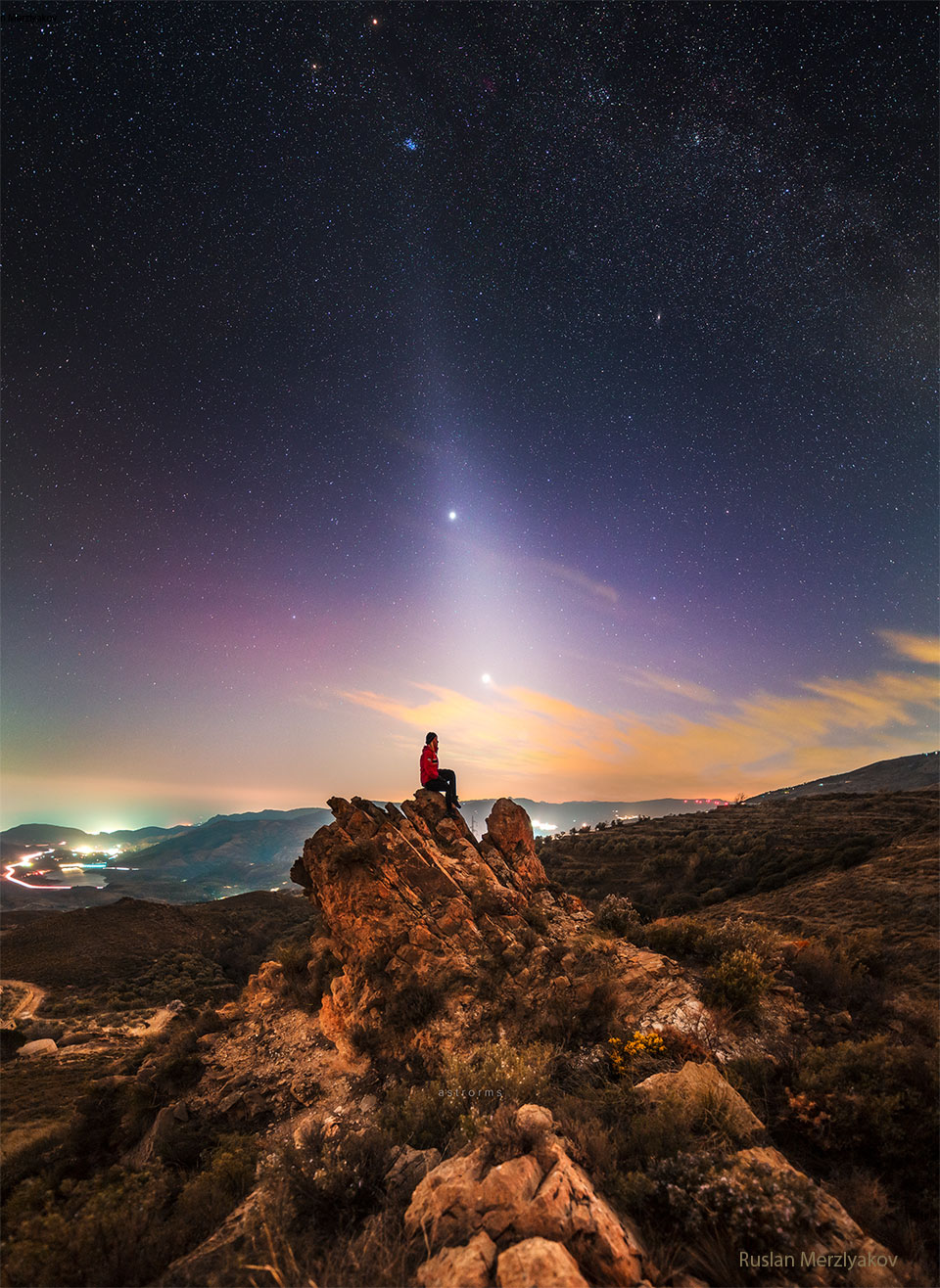
What's causing that unusual ray of light extending from the horizon? Dust orbiting the Sun. At certain times of the year, a band of sun-reflecting dust from the inner Solar System appears prominently after sunset or before sunrise and is called zodiacal light. The dust was emitted mostly from faint Jupiter-family comets and slowly spirals into the Sun. The featured HDR image, acquired in mid-February from the Sierra Nevada National Park in Spain, captures the glowing band of zodiacal light going right in front of the bright evening planets Jupiter (upper) and Venus (lower). Emitted from well behind the zodiacal light is a dark night sky that prominently includes the Pleiades star cluster. Jupiter and Venus are slowly switching places in the evening sky, and just in the next few days nearing their closest angular approach.