The Sun
The Sun is a yellow dwarf star (G2V), about 4.6 billion years old, and the dominant gravitational force in the Solar System. It has a diameter of roughly 1.4 million kilometers and contains around 99.8% of the Solar System’s mass. Nuclear fusion in its core converts hydrogen into helium, producing energy that warms the planets. Above the core lie the radiative and convective zones, followed by the visible photosphere (~5,500 °C), the chromosphere, and the much hotter corona (~2 million °C).
Source: science.nasa.gov
APODs including "The Sun"
Crescent Moon Beyond Greek Temple
28/02/2023
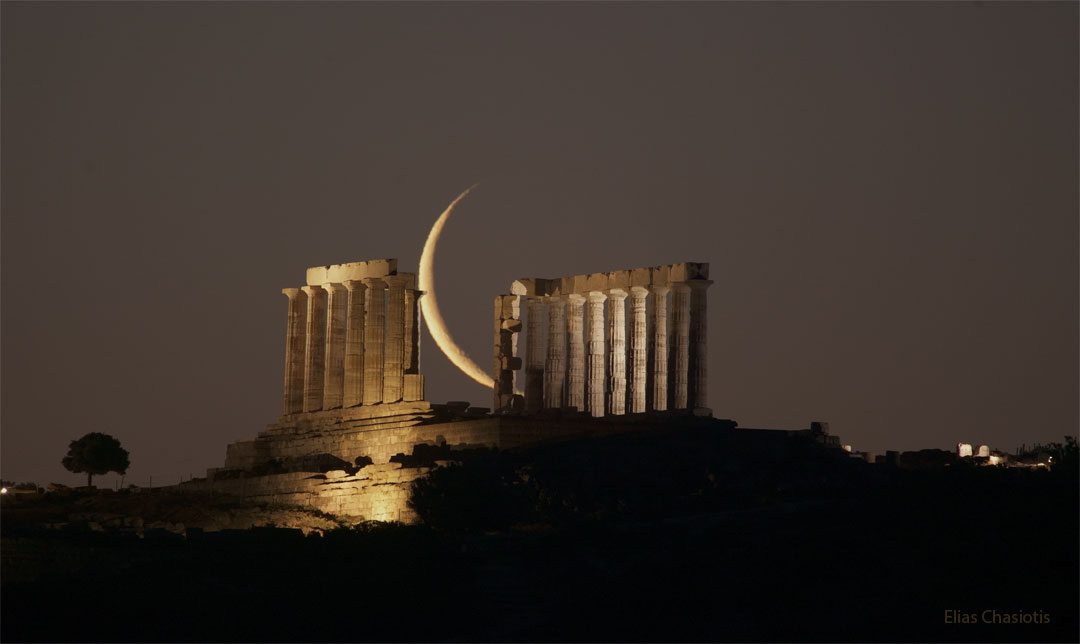
Why is a thin crescent moon never seen far from a horizon? Because the only geometry that gives a thin crescent lunar phase occurs when the Moon appears close to the Sun in the sky. The crescent is not caused by the shadow of the Earth, but by seeing only a small part of the Moon directly illuminated by the Sun. Moreover, the thickest part of the crescent always occurs in the direction of the Sun. In the evening, a thin crescent Moon will set shortly after the Sun and not be seen for the rest of the night. Alternatively, in the morning, a crescent Moon will rise shortly before the Sun after not being seen for most of the night. Pictured two weeks ago, a crescent moon was captured near the horizon, just before sunrise, far behind remnants of the ancient Temple of Poseidon in Greece.