The Sun
The Sun is a yellow dwarf star (G2V), about 4.6 billion years old, and the dominant gravitational force in the Solar System. It has a diameter of roughly 1.4 million kilometers and contains around 99.8% of the Solar System’s mass. Nuclear fusion in its core converts hydrogen into helium, producing energy that warms the planets. Above the core lie the radiative and convective zones, followed by the visible photosphere (~5,500 °C), the chromosphere, and the much hotter corona (~2 million °C).
Source: science.nasa.gov
APODs including "The Sun"
10 Days of Venus and Jupiter
04/03/2023
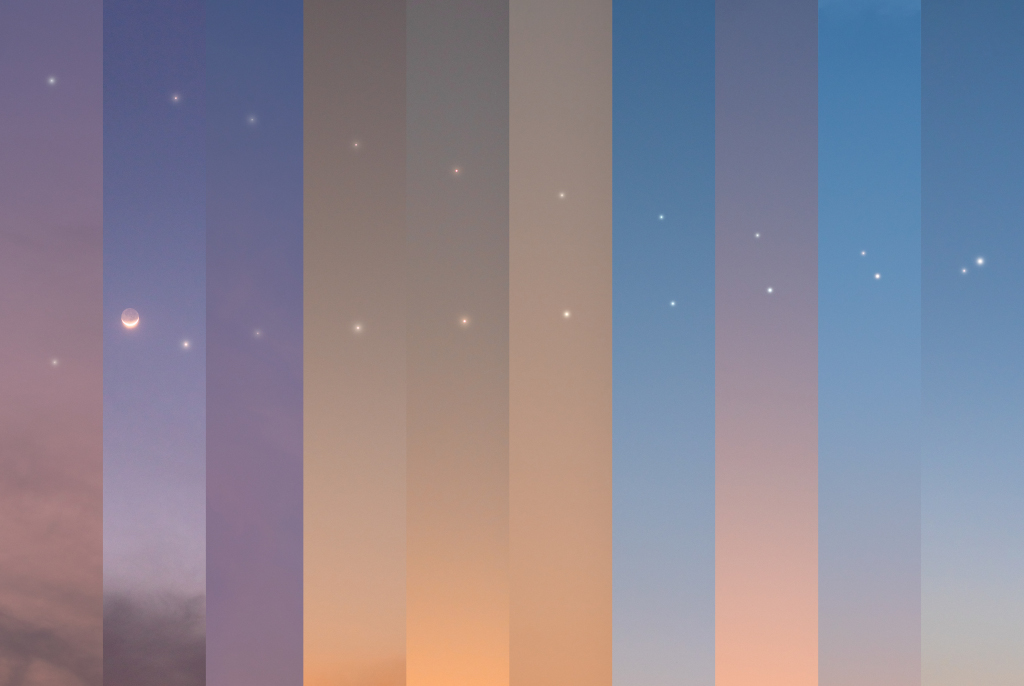
Venus and Jupiter may have caught your attention lately. The impending close conjunction of the two brightest planets visible in clear evening skies has been hard to miss. With Jupiter at the top, starting on February 21 and ending on March 2, their close approach is chronicled daily, left to right, in these panels from Dhanbad, India. Near the western horizon, the evening sky colors and exposures used for each panel depend on the local conditions near sunset. On February 22, Jupiter and Venus were joined by the young crescent Moon. The celestial pair appeared to be only the width of a full moon apart by March 2. Of course on that date the two planets were physically separated by over 600 million kilometers in their orbits around the Sun. In the coming days Jupiter will slowly settle into the glare at sunset, but Venus will continue to move farther from the Sun in the western sky to excel in its current role as the brilliant evening star. Jupiter & Venus Conjunction Gallery: Notable Submissions to APOD