The Sun
The Sun is a yellow dwarf star (G2V), about 4.6 billion years old, and the dominant gravitational force in the Solar System. It has a diameter of roughly 1.4 million kilometers and contains around 99.8% of the Solar System’s mass. Nuclear fusion in its core converts hydrogen into helium, producing energy that warms the planets. Above the core lie the radiative and convective zones, followed by the visible photosphere (~5,500 °C), the chromosphere, and the much hotter corona (~2 million °C).
Source: science.nasa.gov
APODs including "The Sun"
Jupiter and Venus over Italy
05/03/2023
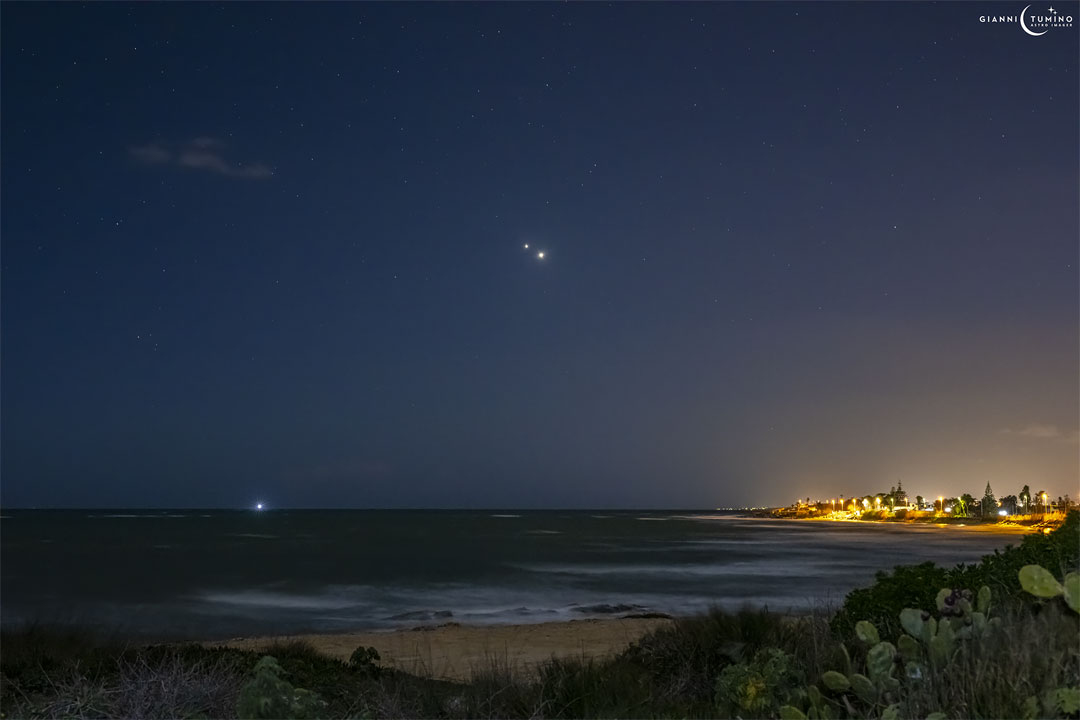
What are those two bright spots? Planets. A few days ago, the two brightest planets in the night sky passed within a single degree of each other in what is termed a conjunction. Visible just after sunset in much of the world, the two bright spots were Jupiter (left) and Venus (right). The featured image was taken near closest approach from Cirica, Sicily, Italy. The week before, Venus was rising higher in the sunset sky to meet the dropping Jupiter. Now they have switched places. Of course, Venus remains much closer to both the Sun and the Earth than Jupiter -- the apparent closeness between the planets in the sky of Earth was only angular. You can still see the popular pair for an hour or so after sunset this month although they continue to separate, and Jupiter continues to set earlier each night. Jupiter & Venus Conjunction Gallery: Notable Submissions to APOD