The Sun
The Sun is a yellow dwarf star (G2V), about 4.6 billion years old, and the dominant gravitational force in the Solar System. It has a diameter of roughly 1.4 million kilometers and contains around 99.8% of the Solar System’s mass. Nuclear fusion in its core converts hydrogen into helium, producing energy that warms the planets. Above the core lie the radiative and convective zones, followed by the visible photosphere (~5,500 °C), the chromosphere, and the much hotter corona (~2 million °C).
Source: science.nasa.gov
APODs including "The Sun"
Jupiter and Venus from Earth
06/03/2023
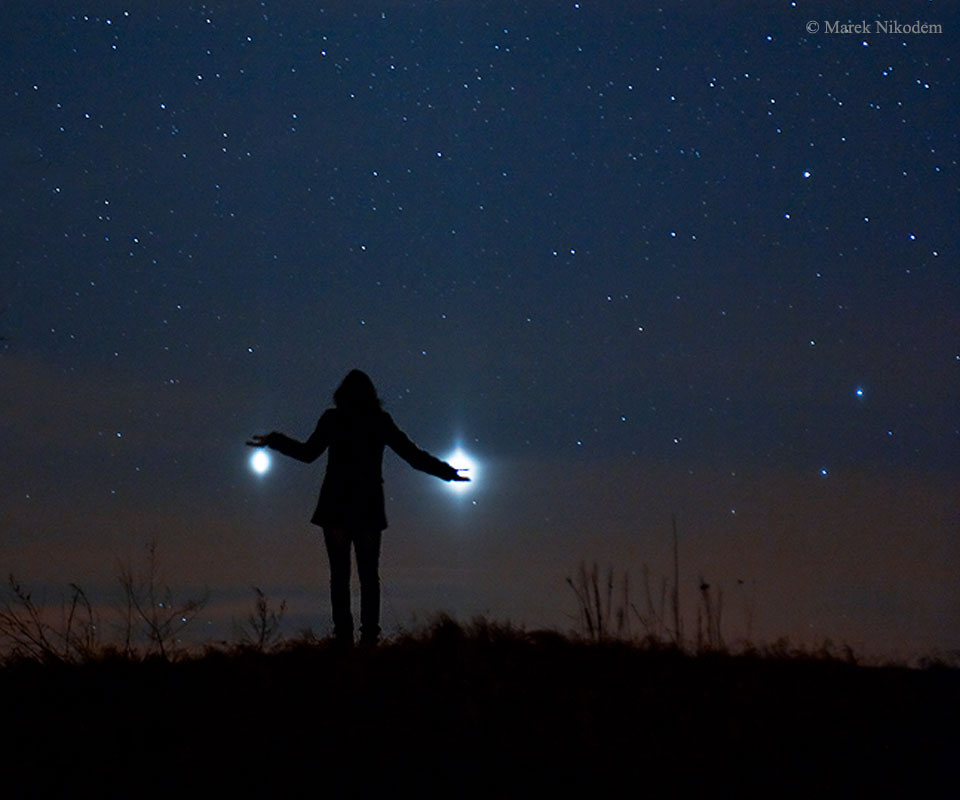
It was visible around the world. The sunset conjunction of Jupiter and Venus in 2012 was visible almost no matter where you lived on Earth. Anyone on the planet with a clear western horizon at sunset could see them. Pictured here in 2012, a creative photographer traveled away from the town lights of Szubin, Poland to image a near closest approach of the two planets. The bright planets were then separated only by three degrees and his daughter struck a humorous pose. A faint red sunset still glowed in the background. Jupiter and Venus are together again this month after sunset, passing within a degree of each other about a week ago. Jupiter & Venus Conjunction Gallery: Notable Submissions to APOD