The Sun
The Sun is a yellow dwarf star (G2V), about 4.6 billion years old, and the dominant gravitational force in the Solar System. It has a diameter of roughly 1.4 million kilometers and contains around 99.8% of the Solar System’s mass. Nuclear fusion in its core converts hydrogen into helium, producing energy that warms the planets. Above the core lie the radiative and convective zones, followed by the visible photosphere (~5,500 °C), the chromosphere, and the much hotter corona (~2 million °C).
Source: science.nasa.gov
APODs including "The Sun"
A Multiple Green Flash Sunset
28/03/2023
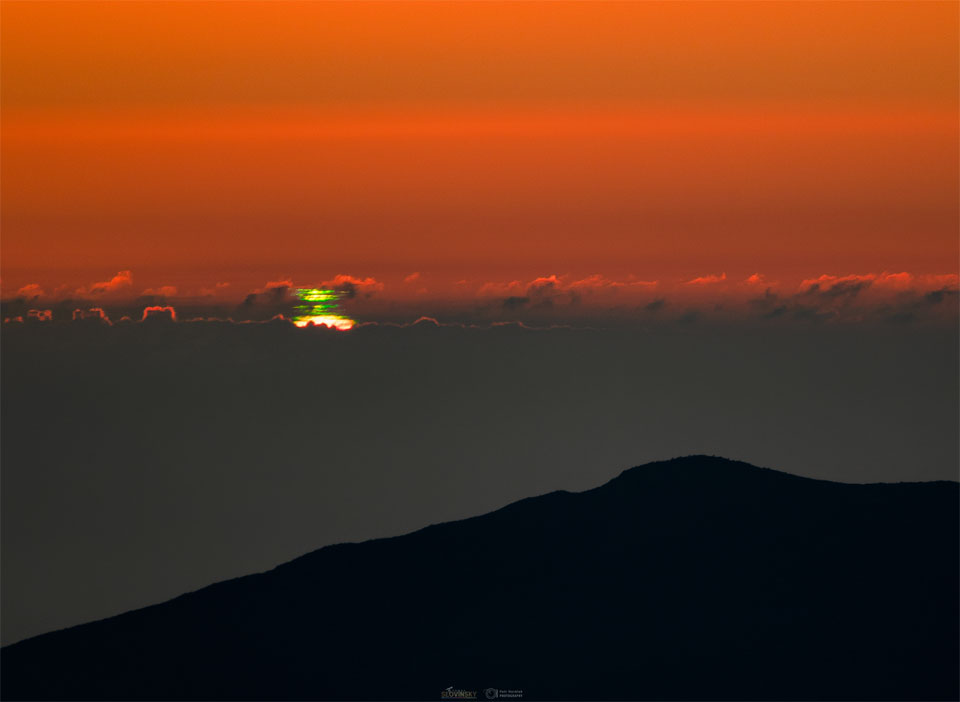
Yes, but can your green flash do this? A green flash at sunset is a rare event that many Sun watchers pride themselves on having seen. Once thought to be a myth, a green flash is now understood to occur when the Earth's atmosphere acts like both a prism and a lens. Different atmospheric layers create altitude-variable refraction that takes light from the top of the Sun and disperses its colors, creates two images, and magnifies it in just the right way to make a thin sliver appear green just before it disappears. Pictured, though, is an even more unusual sunset. From the high-altitude Cerro Tololo Inter-American Observatory in Chile one day last April, the Sun was captured setting beyond an atmosphere with multiple distinct thermal layers, creating several mock images of the Sun. This time and from this location, many of those layers produced a green flash simultaneously. Just seconds after this multiple-green-flash event was caught by two well-surprised astrophotographers, the Sun set below the clouds.