The Sun
The Sun is a yellow dwarf star (G2V), about 4.6 billion years old, and the dominant gravitational force in the Solar System. It has a diameter of roughly 1.4 million kilometers and contains around 99.8% of the Solar System’s mass. Nuclear fusion in its core converts hydrogen into helium, producing energy that warms the planets. Above the core lie the radiative and convective zones, followed by the visible photosphere (~5,500 °C), the chromosphere, and the much hotter corona (~2 million °C).
Source: science.nasa.gov
APODs including "The Sun"
Observatory Aligned with Moon Occulting Jupiter
24/05/2023
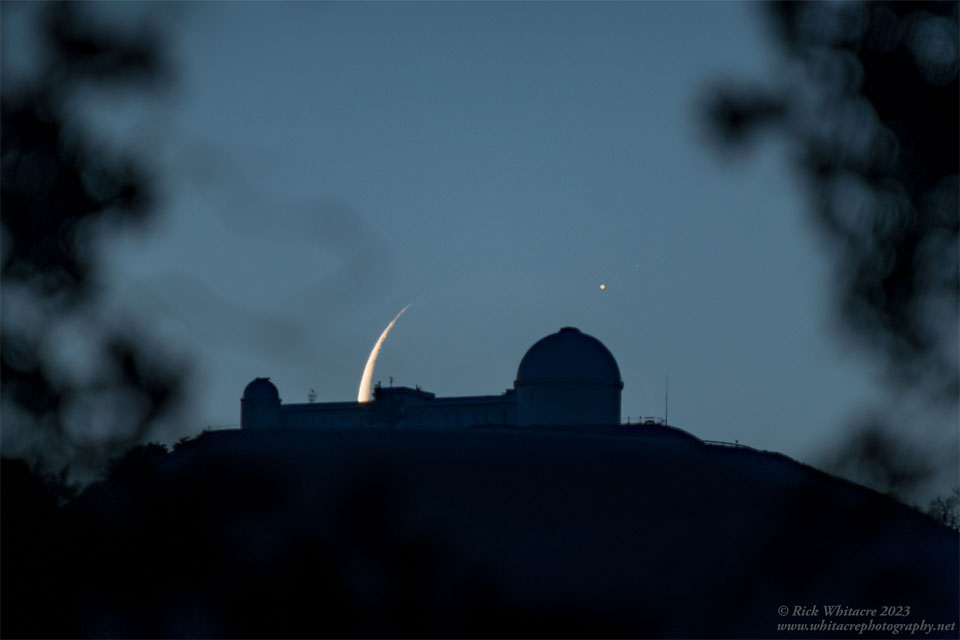
Sometimes we witness the Moon moving directly in front of -- called occulting -- one of the planets in our Solar System. Earlier this month that planet was Jupiter. Captured here was the moment when Jupiter re-appeared from behind the surface of our Moon. The Moon was in its third quarter, two days before the dark New Moon. Now, our Moon is continuously half lit by the Sun, but when in its third quarter, relatively little of that half can be seen from the Earth. Pictured, the Moon itself was aligned behind the famous Lick Observatory in California, USA, on the summit of Mount Hamilton. Coincidentally, Lick enabled the discovery of a moon of Jupiter: Amalthea, the last visually detected moon of Jupiter after Galileo's observations. Gallery: Moon Occults Jupiter in 2023 May: Notable Submissions to APOD