The Sun
The Sun is a yellow dwarf star (G2V), about 4.6 billion years old, and the dominant gravitational force in the Solar System. It has a diameter of roughly 1.4 million kilometers and contains around 99.8% of the Solar System’s mass. Nuclear fusion in its core converts hydrogen into helium, producing energy that warms the planets. Above the core lie the radiative and convective zones, followed by the visible photosphere (~5,500 °C), the chromosphere, and the much hotter corona (~2 million °C).
Source: science.nasa.gov
APODs including "The Sun"
Mars and the Beehive
10/06/2023
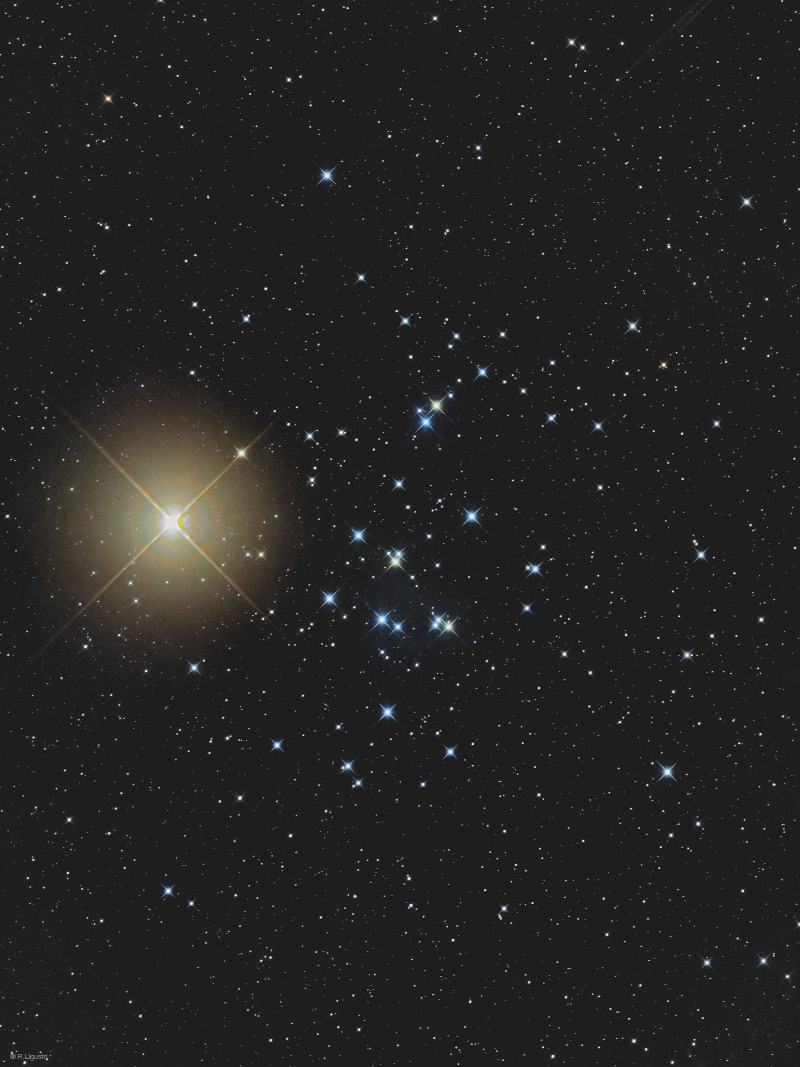
This month, bright Mars and brilliant Venus are the prominent celestial beacons in planet Earth's western skies after sunset. Wandering through the constellation Cancer the Crab, the Red Planet was captured here on the evening of June 3 near the stars of open cluster Messier 44. Recognized since antiquity this nearby, naked-eye star cluster is also known as the Praesepe or the Beehive cluster. A swarm of stars all much younger than the Sun, the Beehive cluster is a mere 600 light-years distant. Seen with a yellowish hue, Mars is about 17 light-minutes away. On June 12/13 Venus will take its turn posing next to the stars of the Beehive cluster. But the dazzling light of Venus will make the Beehive stars difficult to see by eye alone.