The Sun
The Sun is a yellow dwarf star (G2V), about 4.6 billion years old, and the dominant gravitational force in the Solar System. It has a diameter of roughly 1.4 million kilometers and contains around 99.8% of the Solar System’s mass. Nuclear fusion in its core converts hydrogen into helium, producing energy that warms the planets. Above the core lie the radiative and convective zones, followed by the visible photosphere (~5,500 °C), the chromosphere, and the much hotter corona (~2 million °C).
Source: science.nasa.gov
APODs including "The Sun"
The Belt of Venus over Mount Everest
26/06/2023
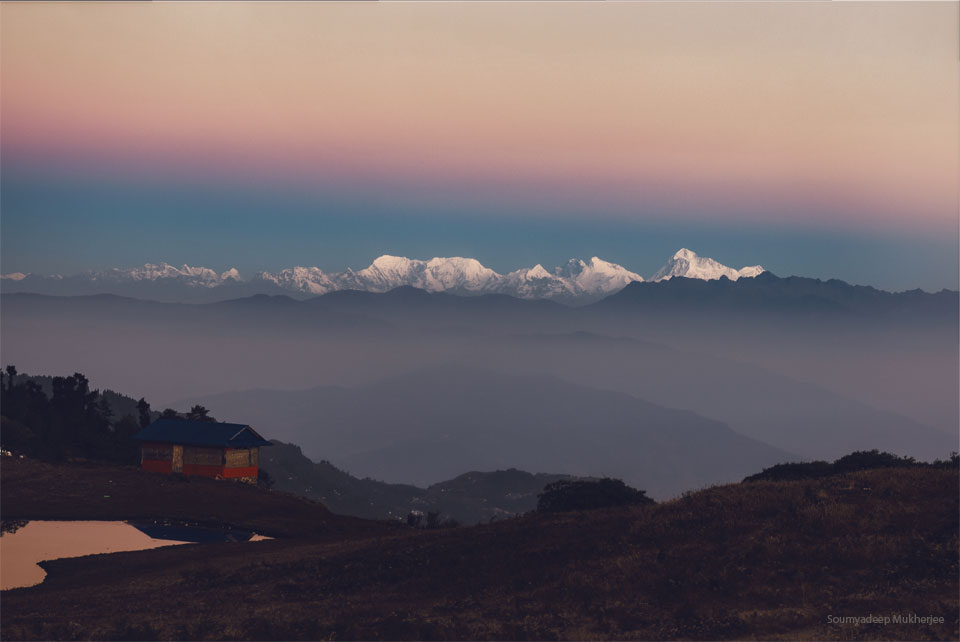
You've surely seen it, but you might not have noticed it. During a cloudless twilight, just before sunrise or after sunset, part of the atmosphere above the horizon appears slightly dark and off-color. Called the Belt of Venus, this transitional band between the dark eclipsed sky and the bright day sky can be seen most prominently in the direction opposite the Sun. Straight above, blue sky is normal sunlight reflecting off the atmosphere, while near the horizon the clear sky can appear more orange or red. In the Belt of Venus, the atmosphere reflects more light from the setting (or rising) Sun and so appears more red. Featured here, the Belt of Venus was photographed over several Himalayan mountains including, second from the right, Mount Everest, the tallest mountain on Earth. Although usually not mentioned, the belt is frequently caught by accident in other photographs.