The Sun
The Sun is a yellow dwarf star (G2V), about 4.6 billion years old, and the dominant gravitational force in the Solar System. It has a diameter of roughly 1.4 million kilometers and contains around 99.8% of the Solar System’s mass. Nuclear fusion in its core converts hydrogen into helium, producing energy that warms the planets. Above the core lie the radiative and convective zones, followed by the visible photosphere (~5,500 °C), the chromosphere, and the much hotter corona (~2 million °C).
Source: science.nasa.gov
APODs including "The Sun"
MAVEN's Ultraviolet Mars
27/06/2023
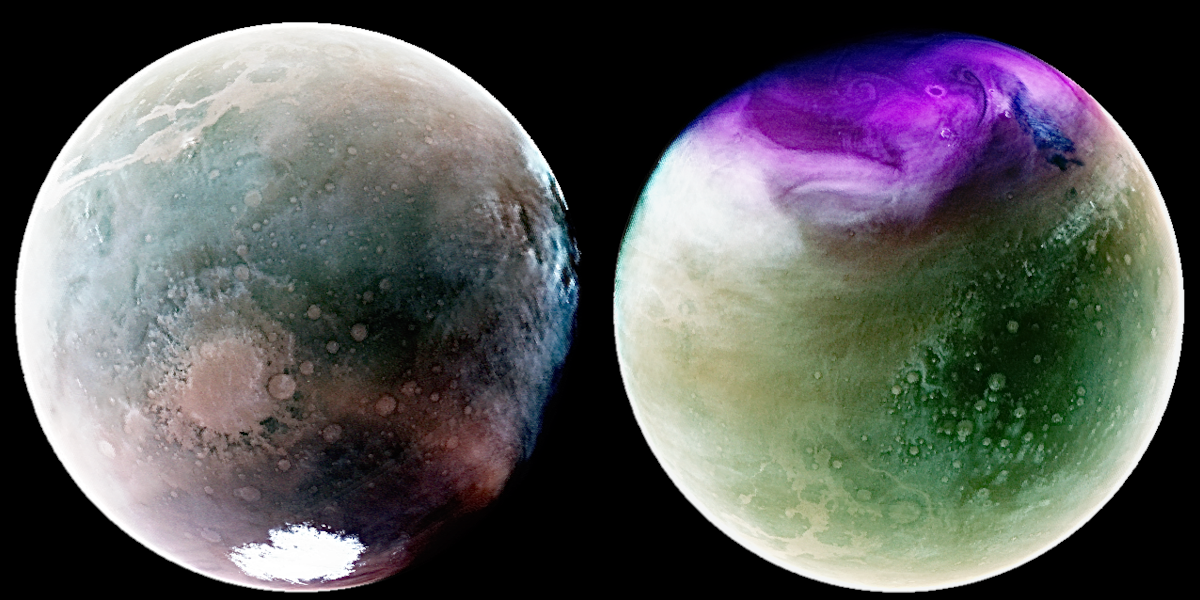
These two global views of Mars were captured at ultraviolet wavelengths, beyond the spectrum visible to human eyes. Recorded by the MAVEN spacecraft's Imaging Ultraviolet Spectrograph instrument in July 2022 (left) and January 2023, three otherwise invisible ultraviolet bands are mapped into red, green, and blue colors. That color scheme presents the Red Planet's surface features in shades of tan and green. Haze and clouds appear white or blue, while high altitude ozone takes on a dramatic purple hue. On the left, Mars' south polar ice cap is in brilliant white at the bottom but shrinking during the southern hemisphere's summer season. On the right, the northern hemisphere's polar region is seen shrouded in clouds and atmospheric ozone. Known to some as the Mars Atmosphere and Volatile EvolutioN spacecraft, MAVEN has been exploring Mars' tenuous upper atmosphere, ionosphere, and its interactions with the Sun and solar wind since 2014.