The Sun
The Sun is a yellow dwarf star (G2V), about 4.6 billion years old, and the dominant gravitational force in the Solar System. It has a diameter of roughly 1.4 million kilometers and contains around 99.8% of the Solar System’s mass. Nuclear fusion in its core converts hydrogen into helium, producing energy that warms the planets. Above the core lie the radiative and convective zones, followed by the visible photosphere (~5,500 °C), the chromosphere, and the much hotter corona (~2 million °C).
Source: science.nasa.gov
APODs including "The Sun"
Milky Way and Aurora over Antarctica
02/07/2023
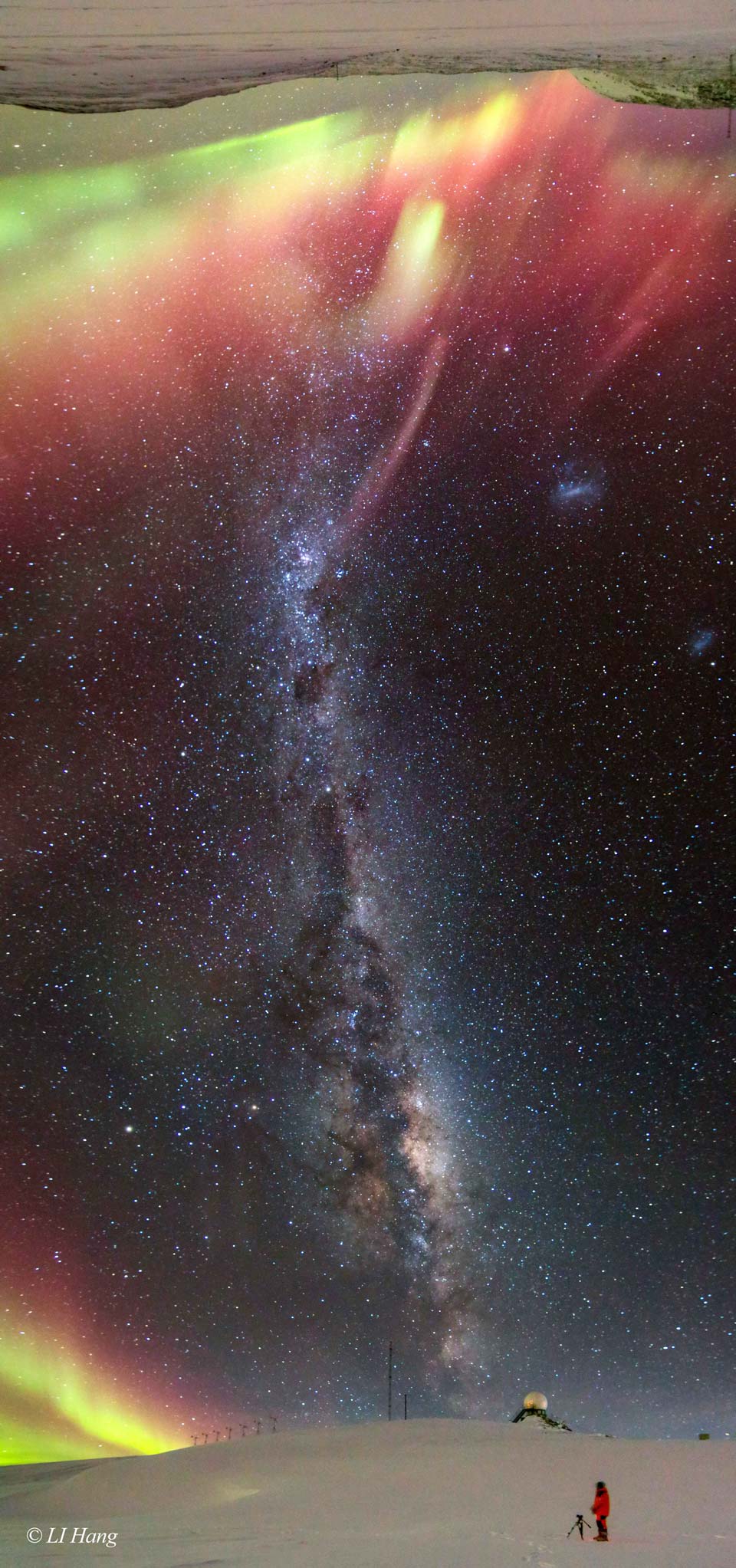
It was one of the better skies of this long night. In parts of Antarctica, not only is it winter, but the Sun can spend weeks below the horizon. At China's Zhongshan Station, people sometimes venture out into the cold to photograph a spectacular night sky. The featured image from one such outing was taken in mid-July of 2015, just before the end of this polar night. Pointing up, the wide angle lens captured not only the ground at the bottom, but at the top as well. In the foreground, a colleague is taking pictures. In the distance, a spherical satellite receiver and several windmills are visible. Numerous stars dot the night sky, including Sirius and Canopus. Far in the background, stretching overhead from horizon to horizon, is the central band of our Milky Way Galaxy. Even further in the distance, visible as extended smudges near the top, are the Large and Small Magellanic Clouds, satellite galaxies near our huge Milky Way Galaxy. Explore the Universe: Random APOD Generator