The Sun
The Sun is a yellow dwarf star (G2V), about 4.6 billion years old, and the dominant gravitational force in the Solar System. It has a diameter of roughly 1.4 million kilometers and contains around 99.8% of the Solar System’s mass. Nuclear fusion in its core converts hydrogen into helium, producing energy that warms the planets. Above the core lie the radiative and convective zones, followed by the visible photosphere (~5,500 °C), the chromosphere, and the much hotter corona (~2 million °C).
Source: science.nasa.gov
APODs including "The Sun"
Comet C/2023 E1 ATLAS near Perihelion
14/07/2023
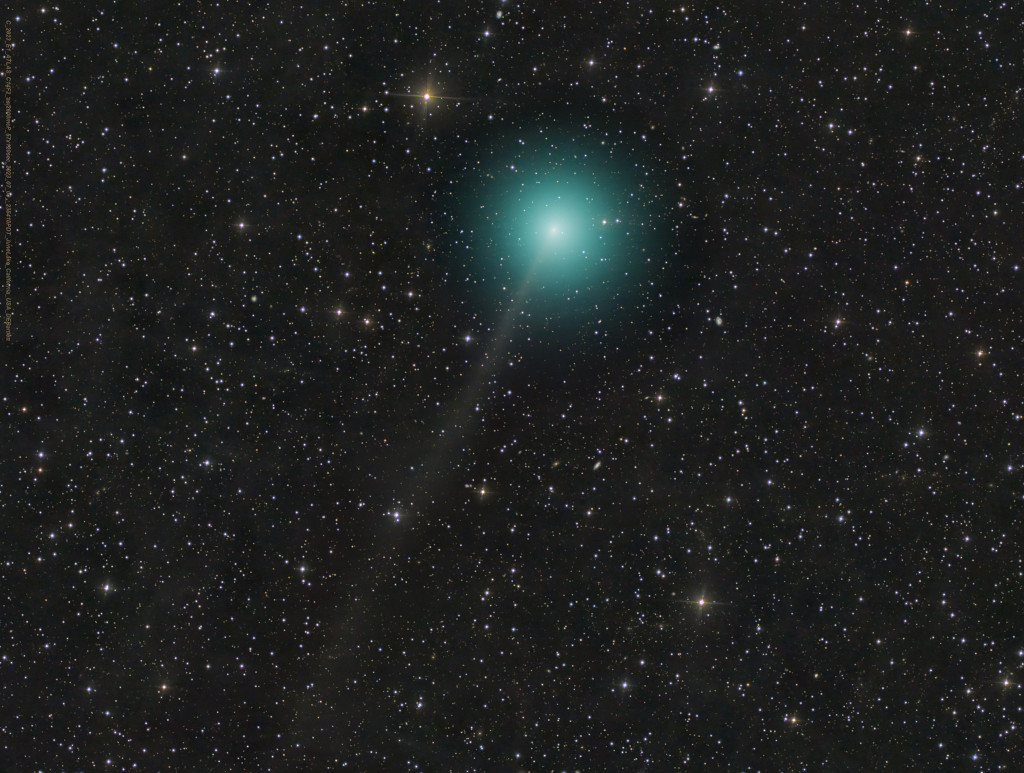
Comet C/2023 E1 (ATLAS) was just spotted in March, another comet found by the NASA funded Asteroid Terrestrial-impact Last Alert System. On July 1 this Comet ATLAS reached perihelion, its closest approach to the Sun. Days later the telescopic comet was captured in this frame sporting a pretty greenish coma and faint, narrow ion tail against a background of stars in the far northern constellation Ursa Minor. This comet's closest approach to Earth is still to come though. On August 18 this visitor to the inner Solar System will be a mere 3 light-minutes or so from our fair planet. Based on its inclination to the ecliptic plane and orbital period of about 85 years C/2023 E1 (ATLAS) is considered a Halley-type comet.