The Sun
The Sun is a yellow dwarf star (G2V), about 4.6 billion years old, and the dominant gravitational force in the Solar System. It has a diameter of roughly 1.4 million kilometers and contains around 99.8% of the Solar System’s mass. Nuclear fusion in its core converts hydrogen into helium, producing energy that warms the planets. Above the core lie the radiative and convective zones, followed by the visible photosphere (~5,500 °C), the chromosphere, and the much hotter corona (~2 million °C).
Source: science.nasa.gov
APODs including "The Sun"
Moonrays of August
04/08/2023
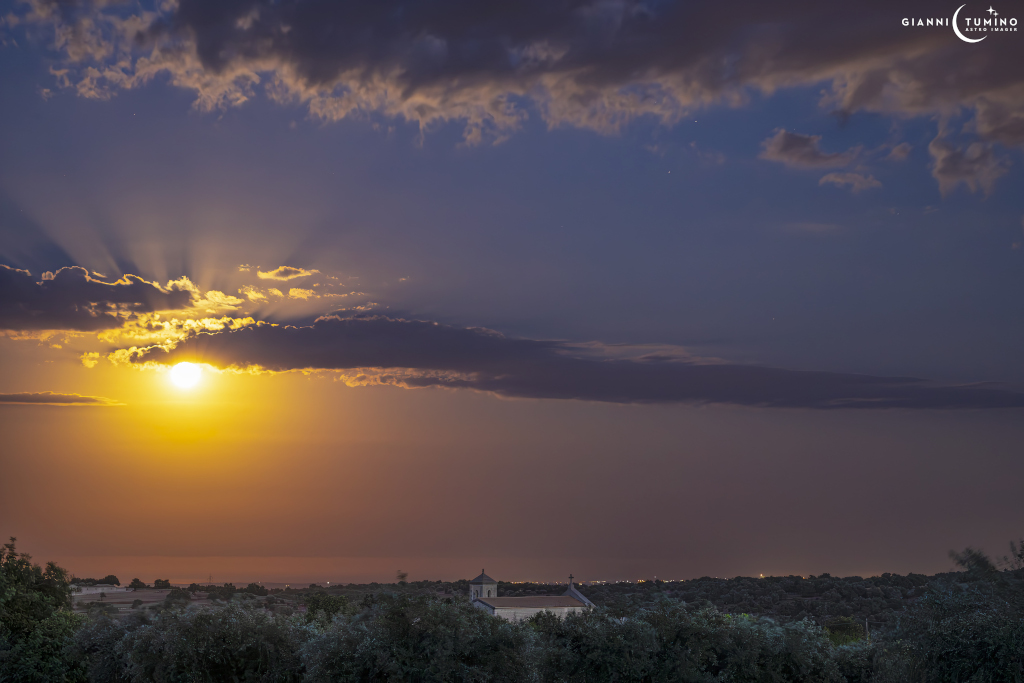
A Full Moon rose as the Sun set on August 1. Near perigee, the closest point in its almost moonthly orbit, the brighter than average lunar disk illuminated night skies around planet Earth as the second supermoon of 2023. Seen here above Ragusa, Sicily, cloud banks cast diverging shadows through the supermoonlit skies, creating dramatic lunar crepuscular rays. The next Full Moon in 2023 will also shine on an August night. Rising as the Sun sets on August 30/31, this second Full Moon in a month is known as a Blue Moon. Blue moons occur only once every 2 or 3 years because lunar phases take almost a calendar month (29.5 days) to go through a complete cycle. But August's Blue Moon will also be near perigee, the third supermoon in 2023.