The Sun
The Sun is a yellow dwarf star (G2V), about 4.6 billion years old, and the dominant gravitational force in the Solar System. It has a diameter of roughly 1.4 million kilometers and contains around 99.8% of the Solar System’s mass. Nuclear fusion in its core converts hydrogen into helium, producing energy that warms the planets. Above the core lie the radiative and convective zones, followed by the visible photosphere (~5,500 °C), the chromosphere, and the much hotter corona (~2 million °C).
Source: science.nasa.gov
APODs including "The Sun"
Ghirigori - Star Scribbles
12/08/2023
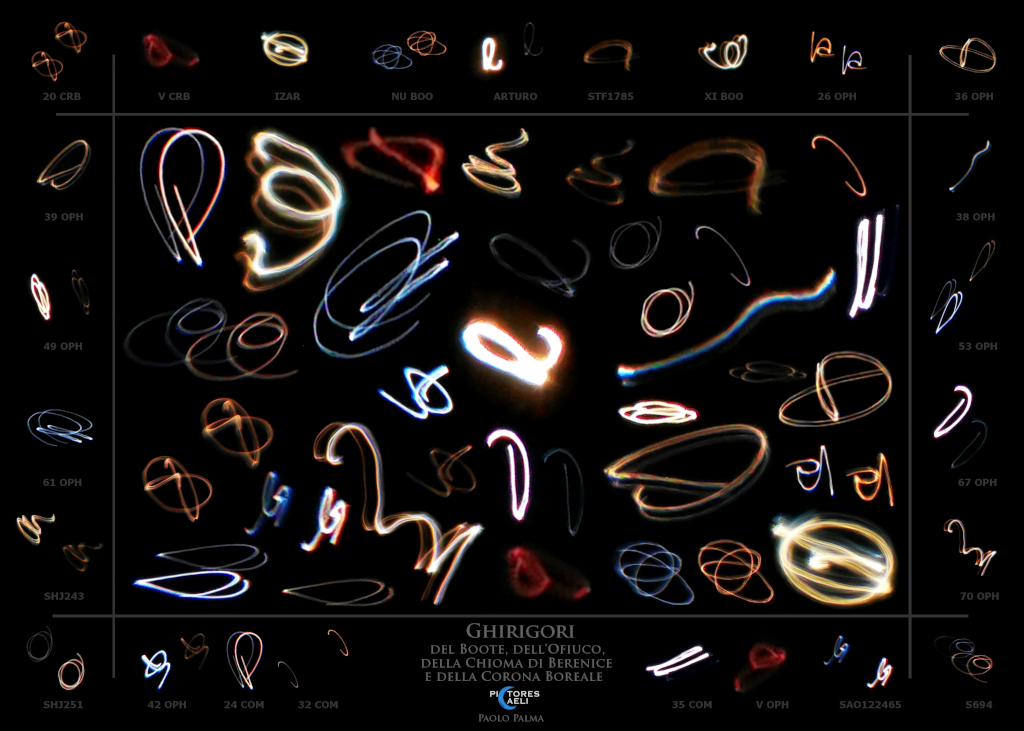
It's fun to scribble on the canvas of the sky. You can use a creative photographic technique to cause the light of point-like stars to dance across a digital image by tapping lightly on the telescope while making an exposure. The result will be a squiggly line traced by the star (or two squiggles traced by binary stars) that can reveal the star's color. Colorful lines, dubbed Ghirigori, made from stars found in the northern sky constellations Bootes, Corona Borealis, Ophiucus, and Coma Berenices, are captured in this artistic mosaic. The 25 stars creating the varied and colorful squiggles are identified around the border. Of course, temperature determines the color of a star. While whitish stars tend to be close to the Sun's temperature, stars with bluer hues are hotter, and yellow and red colors are cooler than the Sun. Weekend Watch: Perseid Meteor Shower