The Sun
The Sun is a yellow dwarf star (G2V), about 4.6 billion years old, and the dominant gravitational force in the Solar System. It has a diameter of roughly 1.4 million kilometers and contains around 99.8% of the Solar System’s mass. Nuclear fusion in its core converts hydrogen into helium, producing energy that warms the planets. Above the core lie the radiative and convective zones, followed by the visible photosphere (~5,500 °C), the chromosphere, and the much hotter corona (~2 million °C).
Source: science.nasa.gov
APODs including "The Sun"
A Triply Glowing Night Sky over Iceland
15/08/2023
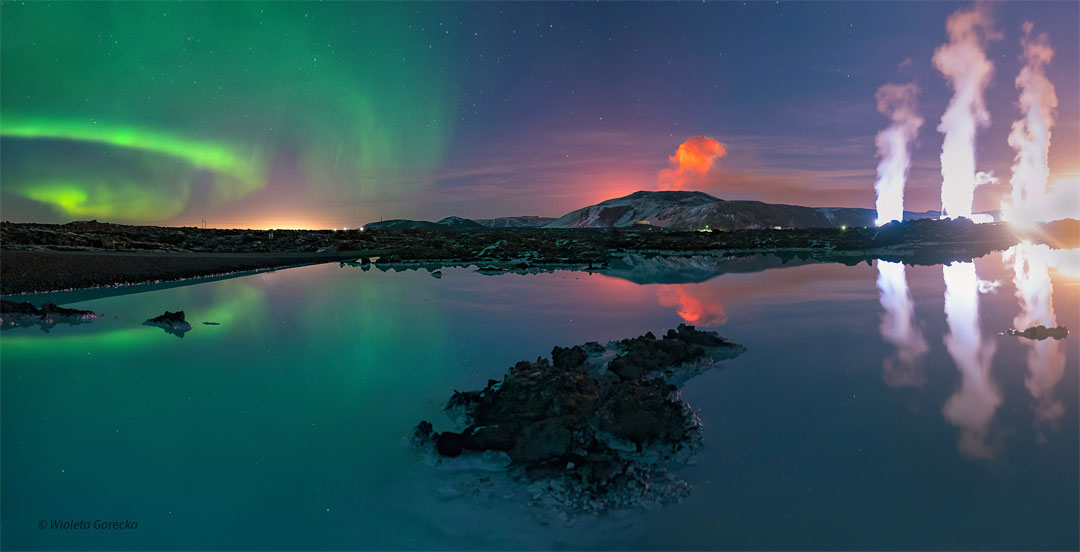
The Sun is not the quiet place it seems. It expels an unsteady stream of energetic electrons and protons known as the solar wind. These charged particles deform the Earth's magnetosphere, change paths, and collide with atoms in Earth's atmosphere, causing the generation of light in auroras like that visible in green in the image left. Earth itself is also geologically active and covered with volcanoes. For example, Fagradalsfjall volcano in Iceland, seen emitting hot gas in orange near the image center. Iceland is one of the most geologically active places on Earth. On the far right is the Svartsengi geothermal power plant which creates the famous human-made Blue Lagoon, shown emitting white gas plumes. The featured composition therefore highlights three different sky phenomena, including both natural and human-made phenomena.