The Sun
The Sun is a yellow dwarf star (G2V), about 4.6 billion years old, and the dominant gravitational force in the Solar System. It has a diameter of roughly 1.4 million kilometers and contains around 99.8% of the Solar System’s mass. Nuclear fusion in its core converts hydrogen into helium, producing energy that warms the planets. Above the core lie the radiative and convective zones, followed by the visible photosphere (~5,500 °C), the chromosphere, and the much hotter corona (~2 million °C).
Source: science.nasa.gov
APODs including "The Sun"
Comet Nishimura Grows
09/09/2023
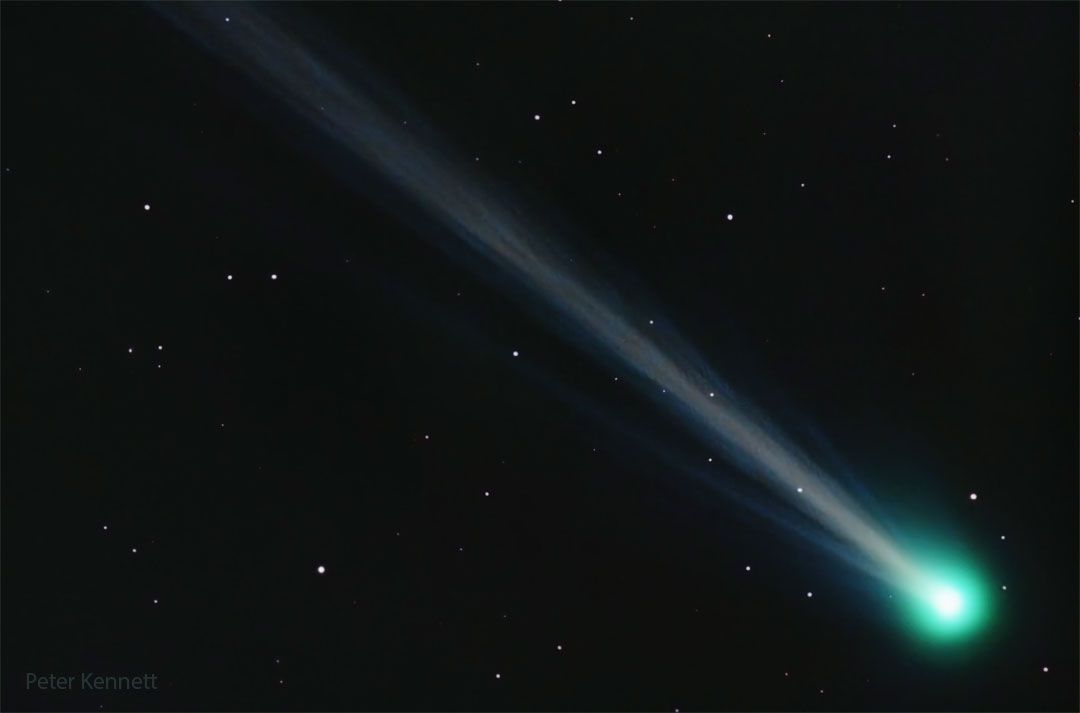
Comet Nishimura is growing. More precisely, the tails C/2023 P1 (Nishimura) are growing as it nears the Sun. Discovered only last month, the comet is already near naked eye brightness as it now moves inside the Earth's orbit. The comet will be nearest the Earth next week, but nearest the Sun the week after -- on September 17. Speculation holds that expelled ice and dust from Comet Nishimura's last visit to the inner Solar System may have created the Sigma Hydrids meteor shower which peaks yearly in December. If so, then this meteor shower may become more active, refreshed with new comet debris. Pictured, Comet Nishimura was captured from Edgewood, New Mexico, USA four nights ago, showing a long ion tail structured by interactions with the Sun's wind. Look for this comet near your eastern horizon just before sunrise for the next few mornings, but very near your western horizon just after sunset next week -- as its coma continues to brighten and its tails continue to grow. Gallery: Selected Comet Nishimura images submitted to APOD