The Sun
The Sun is a yellow dwarf star (G2V), about 4.6 billion years old, and the dominant gravitational force in the Solar System. It has a diameter of roughly 1.4 million kilometers and contains around 99.8% of the Solar System’s mass. Nuclear fusion in its core converts hydrogen into helium, producing energy that warms the planets. Above the core lie the radiative and convective zones, followed by the visible photosphere (~5,500 °C), the chromosphere, and the much hotter corona (~2 million °C).
Source: science.nasa.gov
APODs including "The Sun"
Beautiful Comet Nishimura
11/09/2023
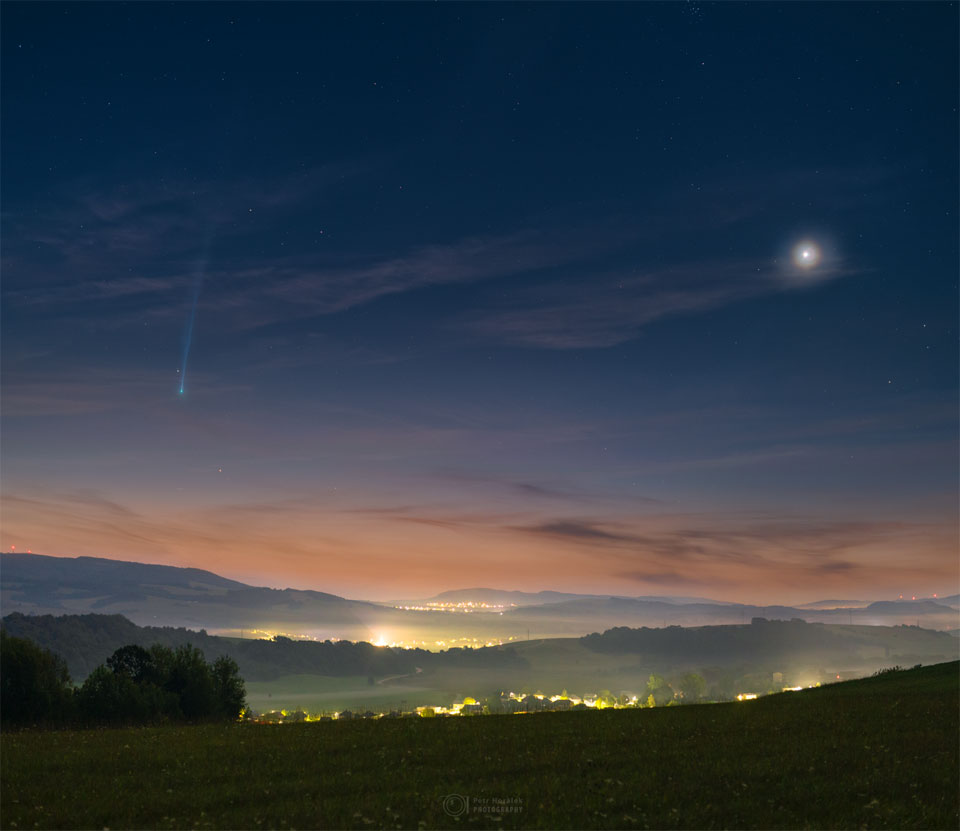
This scene would be beautiful even without the comet. By itself, the sunrise sky is an elegant deep blue on high, with faint white stars peeking through, while near the horizon is a pleasing tan. By itself, the foreground hills of eastern Slovakia are appealingly green, with the Zadňa hura and Veľká hora hills in the distance, and with the lights of small towns along the way. Venus, by itself on the right, appears unusually exquisite, surrounded by a colorful atmospheric corona. But what attracts the eye most is the comet. On the left, in this composite image taken just before dawn yesterday morning, is Comet Nishimura. On recent mornings around the globe, its bright coma and long ion tail make many a morning panoramic photo unusually beautiful. Tomorrow, C/2023 P1 (Nishimura) will pass its nearest to the Earth for about the next 434 years.