The Sun
The Sun is a yellow dwarf star (G2V), about 4.6 billion years old, and the dominant gravitational force in the Solar System. It has a diameter of roughly 1.4 million kilometers and contains around 99.8% of the Solar System’s mass. Nuclear fusion in its core converts hydrogen into helium, producing energy that warms the planets. Above the core lie the radiative and convective zones, followed by the visible photosphere (~5,500 °C), the chromosphere, and the much hotter corona (~2 million °C).
Source: science.nasa.gov
APODs including "The Sun"
Afternoon Analemma
23/09/2023
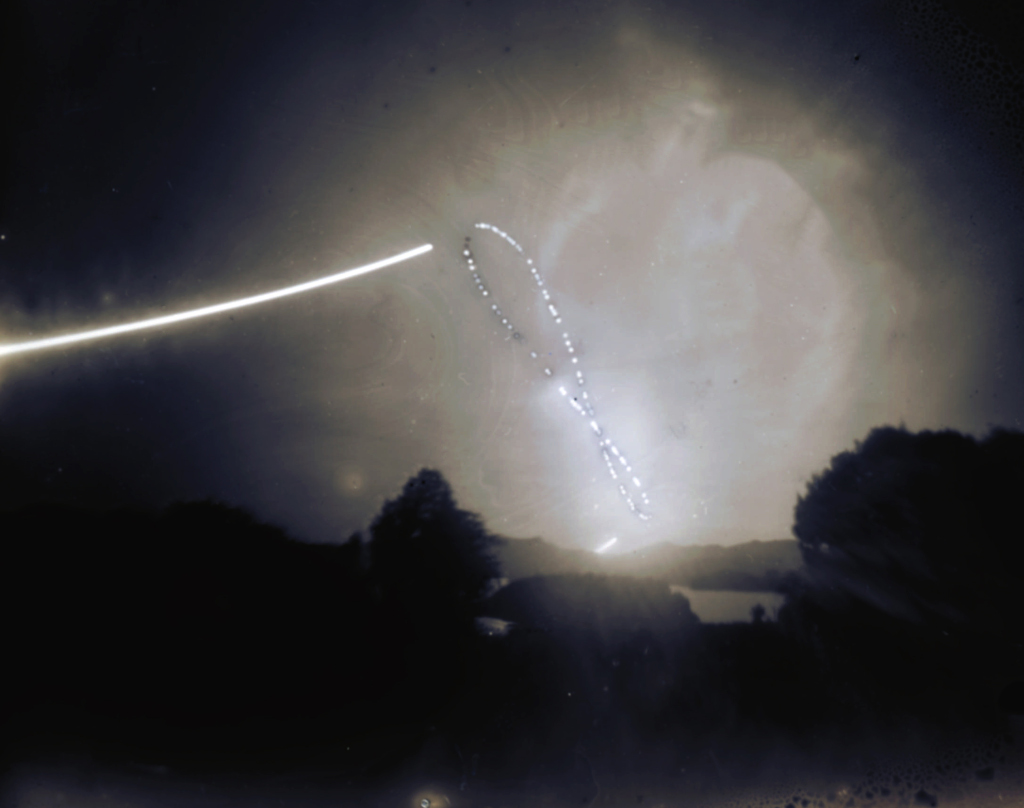
An analemma is that figure-8 curve you get when you mark the position of the Sun at the same time each day for one year. To make this one, a 4x5 pinhole camera was set up looking north in southern New Zealand skies. The shutter was briefly opened each clear day in the afternoon at 4pm local time exposing the same photosensitized glass plate for the year spanning September 23, 2022 to September 19, 2023. On two days, the winter and summer solstices, the shutter was opened again 15 minutes after the main exposure and remained open until sunset to create the sun trails at the bottom and top of the curve. The equinox dates correspond to positions in the middle of the curve, not the crossover point. Of course, the curve itself is inverted compared to an analemma traced from the northern hemisphere. And while fall begins today at the Autumnal Equinox for the northern hemisphere, it's the Spring Equinox in the south.