The Sun
The Sun is a yellow dwarf star (G2V), about 4.6 billion years old, and the dominant gravitational force in the Solar System. It has a diameter of roughly 1.4 million kilometers and contains around 99.8% of the Solar System’s mass. Nuclear fusion in its core converts hydrogen into helium, producing energy that warms the planets. Above the core lie the radiative and convective zones, followed by the visible photosphere (~5,500 °C), the chromosphere, and the much hotter corona (~2 million °C).
Source: science.nasa.gov
APODs including "The Sun"
Ring of Fire over Monument Valley
05/10/2023
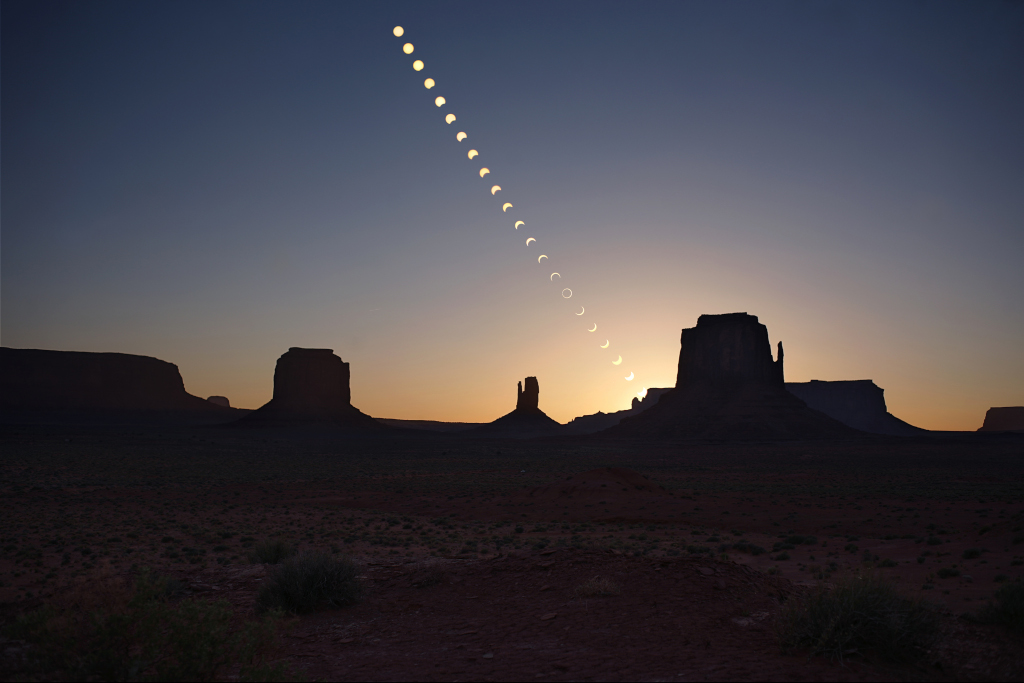
Tracking along a narrow path, the shadow of a new moon will race across North, Central, and South America, on October 14. When viewed from the shadow path the apparent size of the lunar disk will not quite completely cover the Sun though. Instead, the moon in silhouette will appear during the minutes of totality surrounded by a fiery ring, an annular solar eclipse more dramatically known as a ring of fire eclipse. This striking time lapse sequence from May of 2012 illustrates the stages of a ring of fire eclipse. From before eclipse start until sunset, they are seen over the iconic buttes of planet Earth's Monument Valley. Remarkably, the October 14 ring of fire eclipse will also be visible over Monument Valley, beginning after sunrise in the eastern sky.