The Sun
The Sun is a yellow dwarf star (G2V), about 4.6 billion years old, and the dominant gravitational force in the Solar System. It has a diameter of roughly 1.4 million kilometers and contains around 99.8% of the Solar System’s mass. Nuclear fusion in its core converts hydrogen into helium, producing energy that warms the planets. Above the core lie the radiative and convective zones, followed by the visible photosphere (~5,500 °C), the chromosphere, and the much hotter corona (~2 million °C).
Source: science.nasa.gov
APODs including "The Sun"
Plane, Clouds, Moon, Spots, Sun
08/10/2023
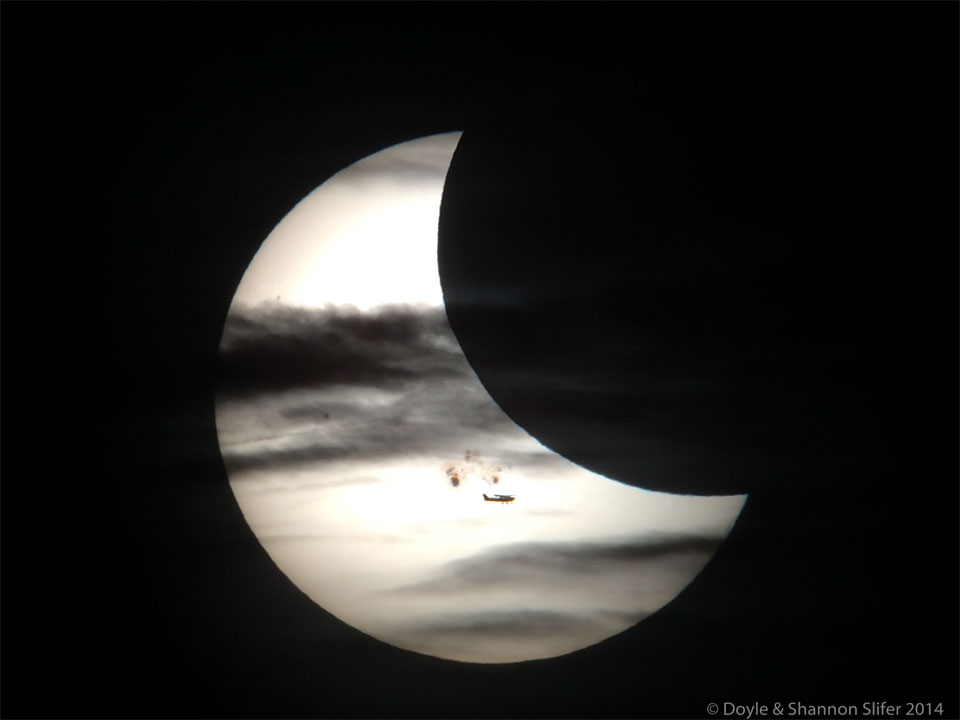
What's that in front of the Sun? The closest object is an airplane, visible just below the Sun's center and caught purely by chance. Next out are numerous clouds in Earth's atmosphere, creating a series of darkened horizontal streaks. Farther out is Earth's Moon, seen as the large dark circular bite on the upper right. Just above the airplane and just below the Sun's surface are sunspots. The main sunspot group captured here, AR 2192, was in 2014 one of the largest ever recorded and had been crackling and bursting with flares since it came around the edge of the Sun a week before. This show of solar silhouettes was unfortunately short-lived. Within a few seconds the plane flew away. Within a few minutes the clouds drifted off. Within a few hours the partial solar eclipse of the Sun by the Moon was over. Fortunately, when it comes to the Sun, even unexpected alignments are surprisingly frequent. Perhaps one will be imaged this Saturday when a new partial solar eclipse will be visible from much of North and South America. APOD editor to speak: in Houghton, Michigan on Thursday, October 12 at 6 pm