The Sun
The Sun is a yellow dwarf star (G2V), about 4.6 billion years old, and the dominant gravitational force in the Solar System. It has a diameter of roughly 1.4 million kilometers and contains around 99.8% of the Solar System’s mass. Nuclear fusion in its core converts hydrogen into helium, producing energy that warms the planets. Above the core lie the radiative and convective zones, followed by the visible photosphere (~5,500 °C), the chromosphere, and the much hotter corona (~2 million °C).
Source: science.nasa.gov
APODs including "The Sun"
Eclipse Rings
16/10/2023
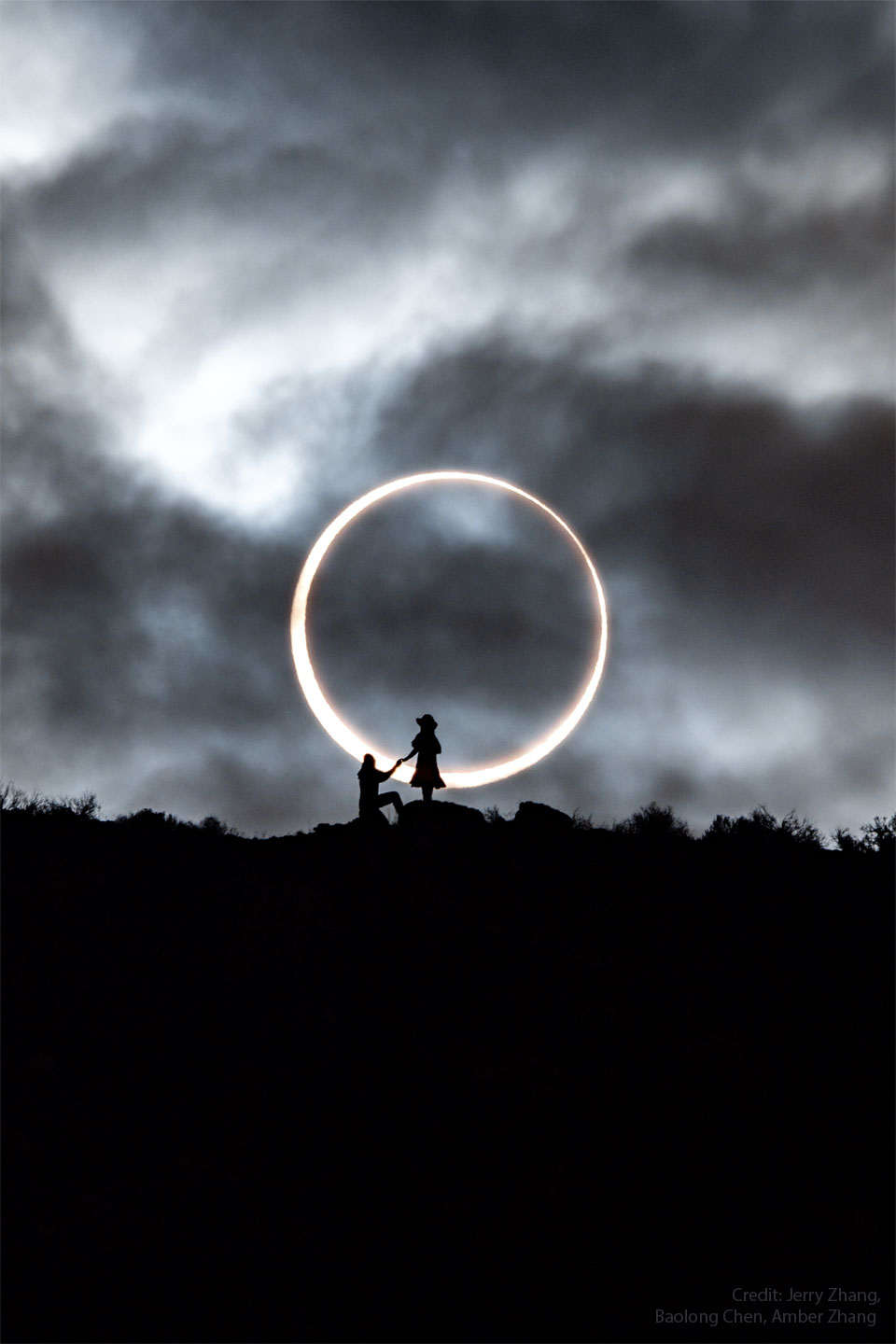
She knew everything but the question. She was well aware that there would be a complete annular eclipse of the Sun visible from their driving destination: Lake Abert in Oregon. She knew that the next ring-of-fire eclipse would occur in the USA only in 16 more years, making this a rare photographic opportunity. She was comfortable with the plan: that she and her boyfriend would appear in front of the eclipse in silhouette, sometimes alone, and sometimes together. She knew that the annular phase of this eclipse would last only a few minutes and she helped in the many hours of planning. She could see their friend who set up the camera about 400 meters away at the bottom of a ridge. What she didn't know was the question she would be asked. But she did know the answer: "yes". Album: Selected eclipse images sent in to APOD