The Sun
The Sun is a yellow dwarf star (G2V), about 4.6 billion years old, and the dominant gravitational force in the Solar System. It has a diameter of roughly 1.4 million kilometers and contains around 99.8% of the Solar System’s mass. Nuclear fusion in its core converts hydrogen into helium, producing energy that warms the planets. Above the core lie the radiative and convective zones, followed by the visible photosphere (~5,500 °C), the chromosphere, and the much hotter corona (~2 million °C).
Source: science.nasa.gov
APODs including "The Sun"
A Sunrise at Sunset Point
19/10/2023
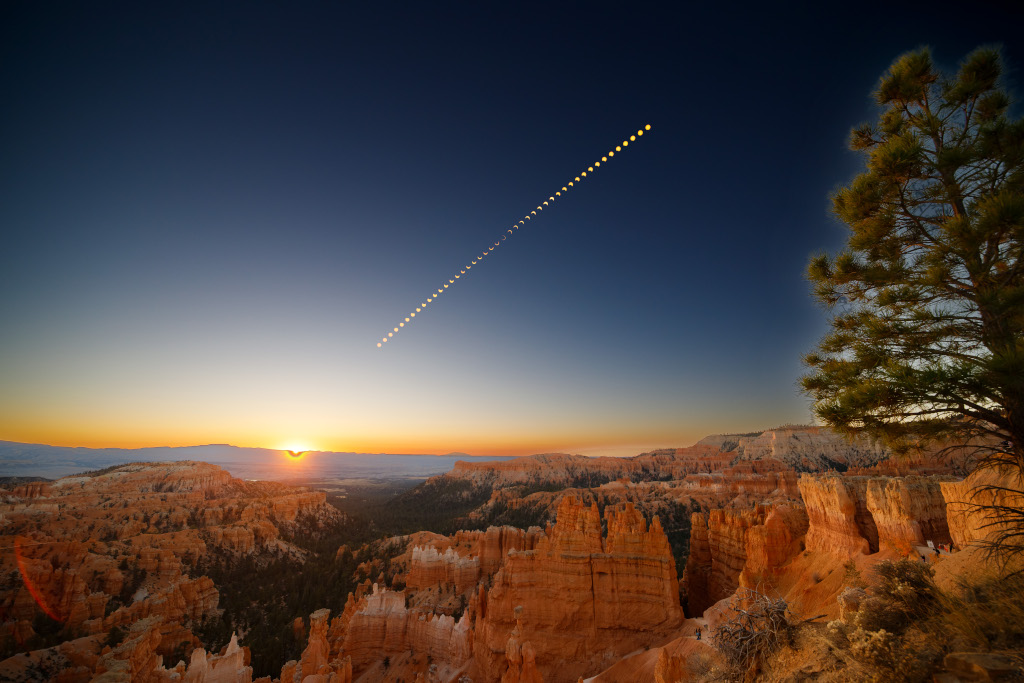
This timelapse series captured on October 14 is set against the sunrise view from Sunset Point, Bryce Canyon, planet Earth. Of course on that date the New Moon caught up with the Sun in the canyon's morning skies. Local temperatures fell as the Moon's shadow swept across the high altitude scene and the brilliant morning sunlight became a more subdued yellow hue cast over the reddish rocky landscape. In the timelapse series, images were taken at 2 minute intervals. The camera and solar filter were fixed to a tripod to follow the phases of the annular solar eclipse. APOD Album: Annular Solar Eclipse of 2023 October