The Sun
The Sun is a yellow dwarf star (G2V), about 4.6 billion years old, and the dominant gravitational force in the Solar System. It has a diameter of roughly 1.4 million kilometers and contains around 99.8% of the Solar System’s mass. Nuclear fusion in its core converts hydrogen into helium, producing energy that warms the planets. Above the core lie the radiative and convective zones, followed by the visible photosphere (~5,500 °C), the chromosphere, and the much hotter corona (~2 million °C).
Source: science.nasa.gov
APODs including "The Sun"
Galaxies and a Comet
20/10/2023
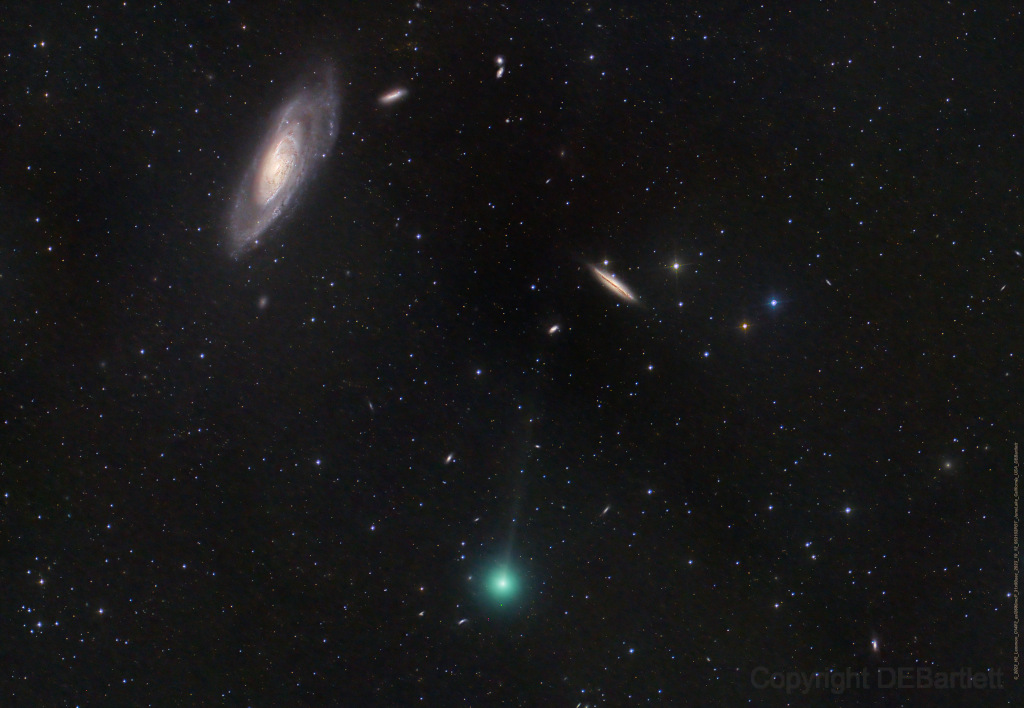
Galaxies abound in this sharp telescopic image recorded on October 12 in dark skies over June Lake, California. The celestial scene spans nearly 2 degrees within the boundaries of the well-trained northern constellation Canes Venatici. Prominent at the upper left 23.5 million light-years distant is big, beautiful spiral galaxy NGC 4258, known to some as Messier 106. Eye-catching edge-on spiral NGC 4217 is above and right of center about 60 million light-years away. Just passing through the pretty field of view is comet C/2023 H2 Lemmon, discovered last April in image data from the Mount Lemmon Survey. Here the comet sports more of a lime green coma though, along with a faint, narrow ion tail stretching toward the top of the frame. This visitor to the inner Solar System is presently less than 7 light-minutes away and still difficult to spot with binoculars, but it's growing brighter. Comet C/2023 H2 Lemmon will reach perihelion, its closest point to the Sun, on October 29 and perigee, its closest to our fair planet, on November 10 as it transitions from morning to evening northern skies.