The Sun
The Sun is a yellow dwarf star (G2V), about 4.6 billion years old, and the dominant gravitational force in the Solar System. It has a diameter of roughly 1.4 million kilometers and contains around 99.8% of the Solar System’s mass. Nuclear fusion in its core converts hydrogen into helium, producing energy that warms the planets. Above the core lie the radiative and convective zones, followed by the visible photosphere (~5,500 °C), the chromosphere, and the much hotter corona (~2 million °C).
Source: science.nasa.gov
APODs including "The Sun"
Three Planets Rock
14/11/2023
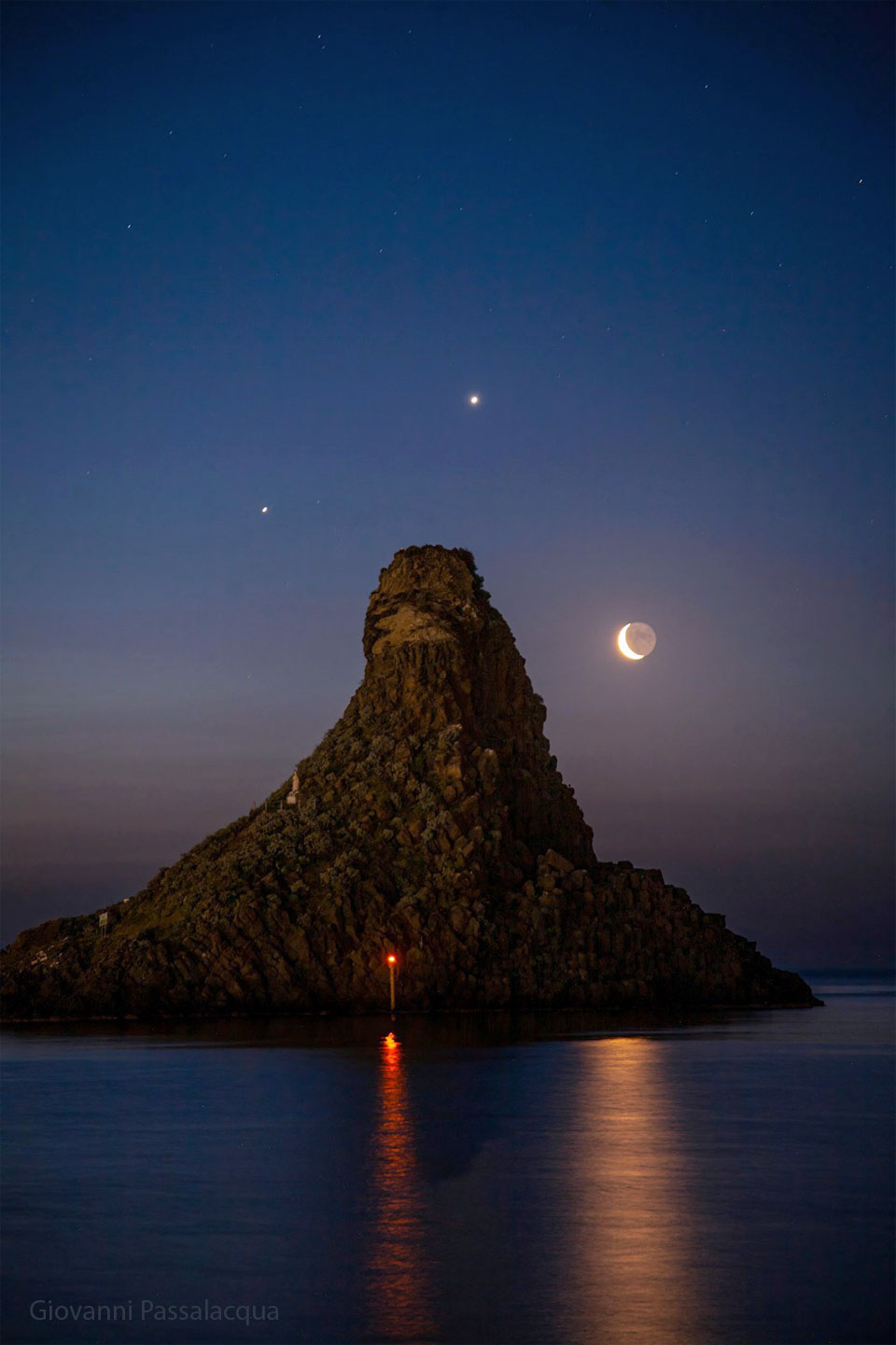
In the fading darkness before dawn, a tilted triangle appeared to balance atop a rock formation off the southern tip of Sicily. Making up the points of the triangle are three of the four brightest objects visible in Earth’s sky: Jupiter, Venus and the Moon. Though a thin waning crescent, most of the moon’s disk is visible due to earthshine. Captured in this image on 2022 April 27, Venus (center) and Jupiter (left) are roughly three degrees apart -- and were headed toward a close conjunction. Conjunctions of Venus and Jupiter occur about once a year and are visible either in the east before sunrise or in the west after sunset. The featured image was taken about an hour before the arrival of the brightest object in Earth’s sky – the Sun.