The Sun
The Sun is a yellow dwarf star (G2V), about 4.6 billion years old, and the dominant gravitational force in the Solar System. It has a diameter of roughly 1.4 million kilometers and contains around 99.8% of the Solar System’s mass. Nuclear fusion in its core converts hydrogen into helium, producing energy that warms the planets. Above the core lie the radiative and convective zones, followed by the visible photosphere (~5,500 °C), the chromosphere, and the much hotter corona (~2 million °C).
Source: science.nasa.gov
APODs including "The Sun"
A Landspout Tornado over Kansas
29/11/2023
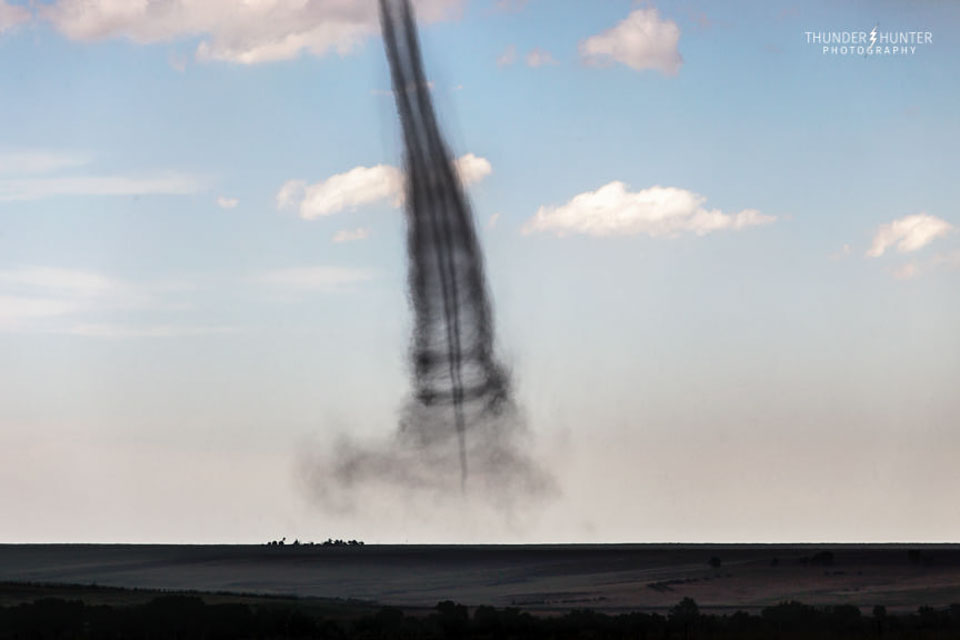
Could there be a tornado inside another tornado? In general, no. OK, but could there be a tornado inside a wider dust devil? No again, for one reason because tornados comes down from the sky, but dust devils rise up from the ground. What is pictured is a landspout, an unusual type of tornado known to occur on the edge of a violent thunderstorm. The featured landspout was imaged and identified in Kansas, USA, in June 2019 by an experienced storm chaser. The real tornado is in the center, and the outer sheath was possibly created by large dust particles thrown out from the central tornado. So far, the only planet known to create tornados is Earth, although tornado-like activity has been found on the Sun and dust devils are common on Mars. Almost Hyperspace: Random APOD Generator