The Sun
The Sun is a yellow dwarf star (G2V), about 4.6 billion years old, and the dominant gravitational force in the Solar System. It has a diameter of roughly 1.4 million kilometers and contains around 99.8% of the Solar System’s mass. Nuclear fusion in its core converts hydrogen into helium, producing energy that warms the planets. Above the core lie the radiative and convective zones, followed by the visible photosphere (~5,500 °C), the chromosphere, and the much hotter corona (~2 million °C).
Source: science.nasa.gov
APODs including "The Sun"
Ice Halos over Bavaria
20/12/2023
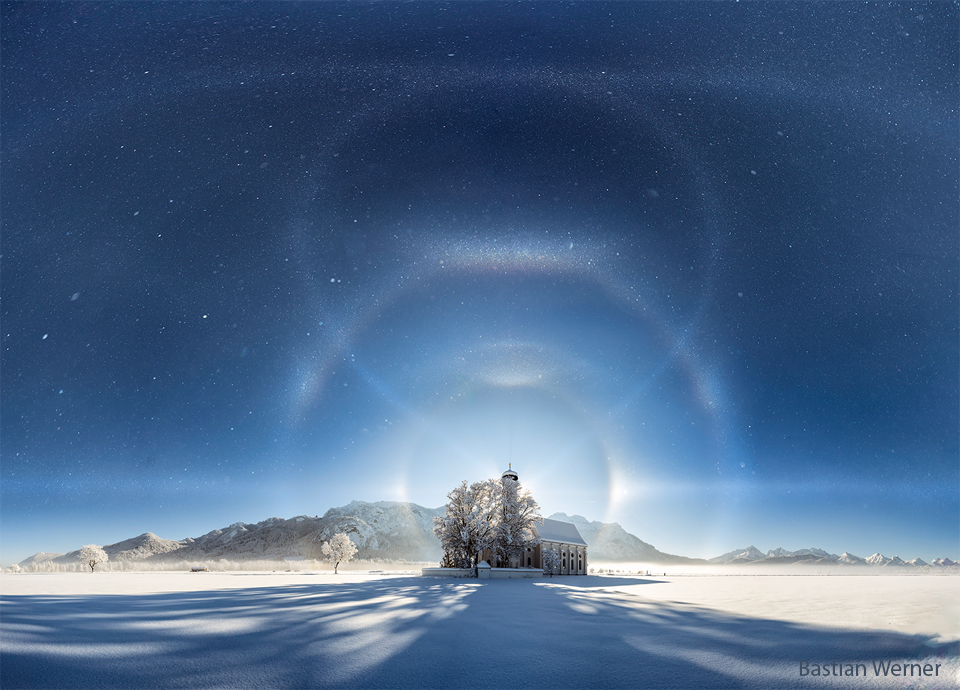
What's causing those unusual sky arcs? Ice crystals. While crossing a field of fresh snow near Füssen, Bavaria, Germany, earlier this month, the photographer noticed that he had entered an ice fog. For suspended water to freeze into an ice fog requires quite cold temperatures, and indeed the air temperature on this day was measured at well below zero. The ice fog reflected light from the Sun setting behind St. Coleman Church. The result was one of the greatest spectacles the photographer has ever seen. First, the spots in the featured picture are not background stars but suspended ice and snow. Next, two prominent ice halos are visible: the 22-degree halo and the 46-degree halo. Multiple arcs are also visible, including, from top to bottom, antisolar (subsun), circumzenithal, Parry, tangent, and parhelic (horizontal). Finally, the balloon shaped curve connecting the top arc to the Sun is the rarest of all: it is the heliac arc, created by reflection from the sides of hexagonally shaped ice crystals suspended in a horizontal orientation.