The Sun
The Sun is a yellow dwarf star (G2V), about 4.6 billion years old, and the dominant gravitational force in the Solar System. It has a diameter of roughly 1.4 million kilometers and contains around 99.8% of the Solar System’s mass. Nuclear fusion in its core converts hydrogen into helium, producing energy that warms the planets. Above the core lie the radiative and convective zones, followed by the visible photosphere (~5,500 °C), the chromosphere, and the much hotter corona (~2 million °C).
Source: science.nasa.gov
APODs including "The Sun"
183 Days in the Sun
22/12/2023
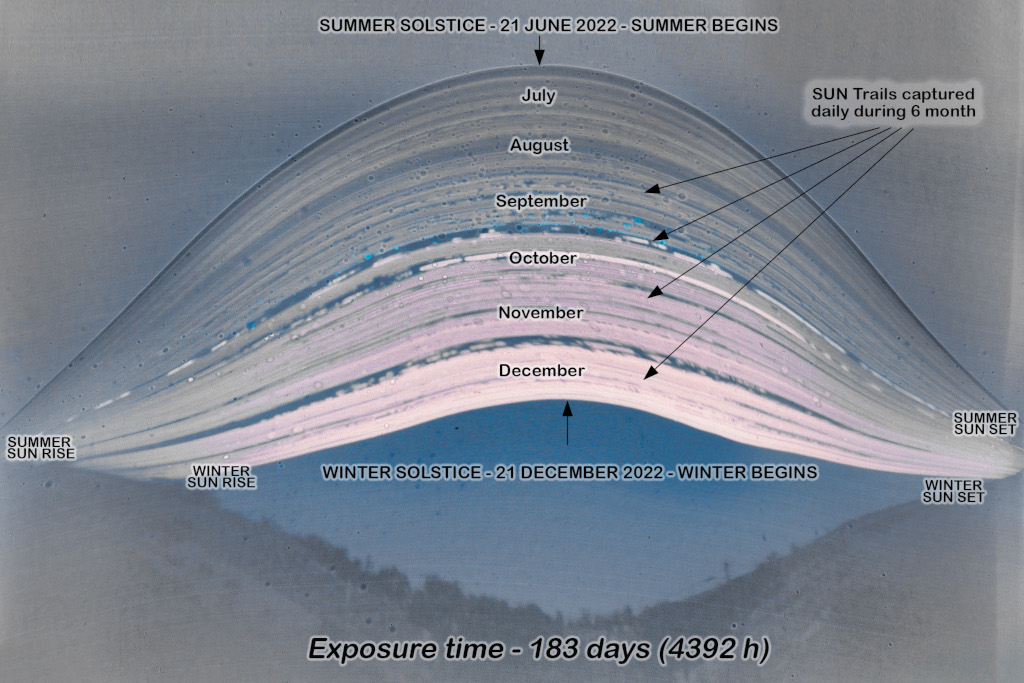
A single 183 day exposure with a pinhole camera and photographic paper resulted in this long-duration solargraph. Recorded from solstice to solstice, June 21 to December 21, in 2022, it follows the Sun's daily arcing path through planet Earth's skies from Mertola, Portugal. On June 21, the Sun's highest point and longest arc represents the longest day and the astronomical beginning of summer in the northern hemisphere. The solstice date with the fewest hours of daylight is at the beginning of winter in the north, corresponding to the Sun's shortest and lowest arc in the 2022 solargraph. For 2023, the northern winter solstice was on December 22 at 3:27 UTC. That's December 21 for North America time zones.