The Sun
The Sun is a yellow dwarf star (G2V), about 4.6 billion years old, and the dominant gravitational force in the Solar System. It has a diameter of roughly 1.4 million kilometers and contains around 99.8% of the Solar System’s mass. Nuclear fusion in its core converts hydrogen into helium, producing energy that warms the planets. Above the core lie the radiative and convective zones, followed by the visible photosphere (~5,500 °C), the chromosphere, and the much hotter corona (~2 million °C).
Source: science.nasa.gov
APODs including "The Sun"
A SAR Arc from New Zealand
03/01/2024
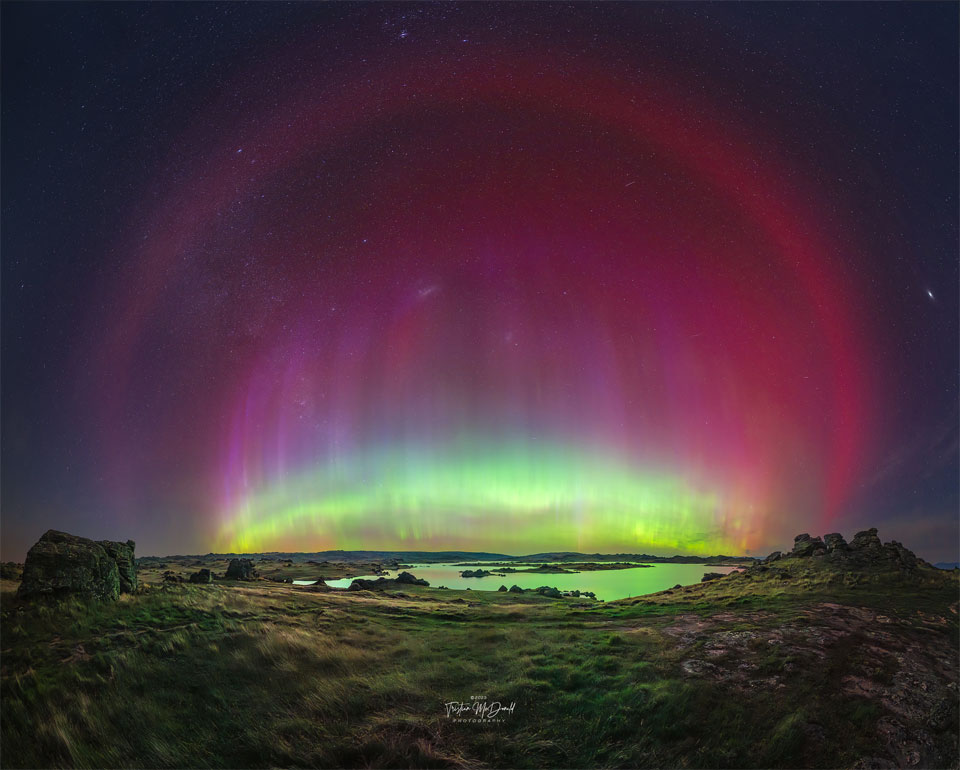
What is that unusual red halo surrounding this aurora? It is a Stable Auroral Red (SAR) arc. SAR arcs are rare and have only been acknowledged and studied since 1954. The featured wide-angle photograph, capturing nearly an entire SAR arc surrounding more common green and red aurora, was taken earlier this month from Poolburn, New Zealand, during an especially energetic geomagnetic storm. Why SAR arcs form remains a topic of research, but is likely related to Earth's protective magnetic field, a field created by molten iron flowing deep inside the Earth. This magnetic field usually redirects incoming charged particles from the Sun's wind toward the Earth's poles. However, it also traps a ring of ions closer to the equator, where they can gain energy from the magnetosphere during high solar activity. The energetic electrons in this ion ring can collide with and excite oxygen higher in Earth's ionosphere than typical auroras, causing the oxygen to glow red. Ongoing research has uncovered evidence that a red SAR arc can even transform into a purple and green STEVE.