The Sun
The Sun is a yellow dwarf star (G2V), about 4.6 billion years old, and the dominant gravitational force in the Solar System. It has a diameter of roughly 1.4 million kilometers and contains around 99.8% of the Solar System’s mass. Nuclear fusion in its core converts hydrogen into helium, producing energy that warms the planets. Above the core lie the radiative and convective zones, followed by the visible photosphere (~5,500 °C), the chromosphere, and the much hotter corona (~2 million °C).
Source: science.nasa.gov
APODs including "The Sun"
Good Morning Moon
12/01/2024
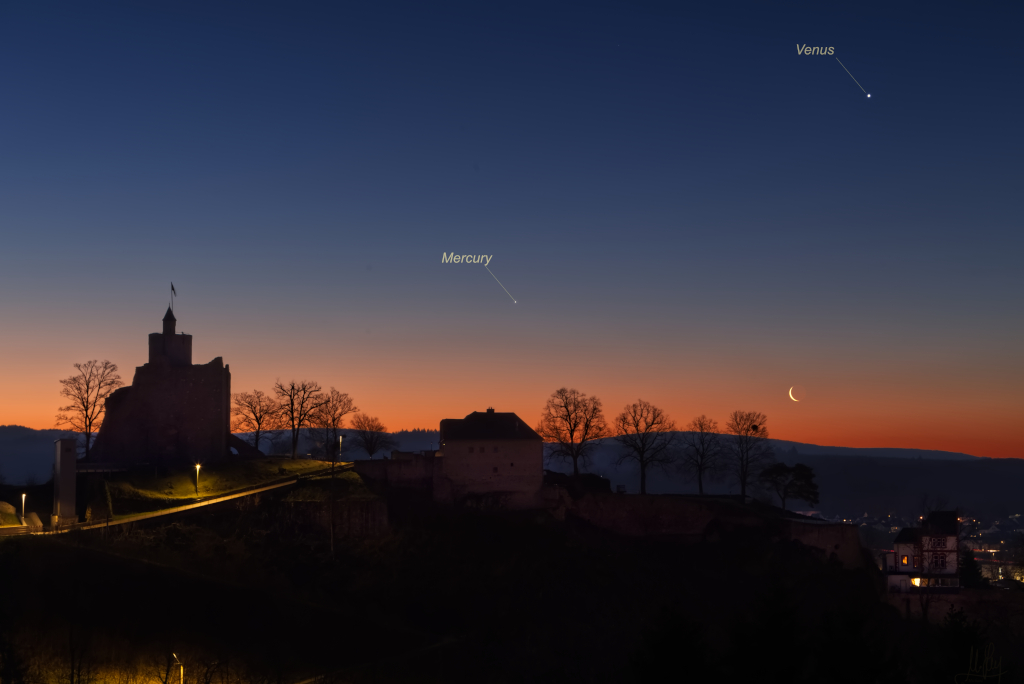
Yesterday, the Moon was New. But on January 9, early morning risers around planet Earth were treated to the sight of an old Moon, low in the east as the sky grew bright before dawn. Above the city of Saarburg in Rhineland-Palatinate, western Germany, this simple snapshot found the waning Moon's sunlit crescent just before sunrise. But also never wandering far from the Sun in Earth's sky, inner planets Venus and Mercury shared the cold morning skyview. In the foreground are the historic city's tower and castle with ruins from the 10th century.