The Sun
The Sun is a yellow dwarf star (G2V), about 4.6 billion years old, and the dominant gravitational force in the Solar System. It has a diameter of roughly 1.4 million kilometers and contains around 99.8% of the Solar System’s mass. Nuclear fusion in its core converts hydrogen into helium, producing energy that warms the planets. Above the core lie the radiative and convective zones, followed by the visible photosphere (~5,500 °C), the chromosphere, and the much hotter corona (~2 million °C).
Source: science.nasa.gov
APODs including "The Sun"
Dragon Aurora over Iceland
14/01/2024
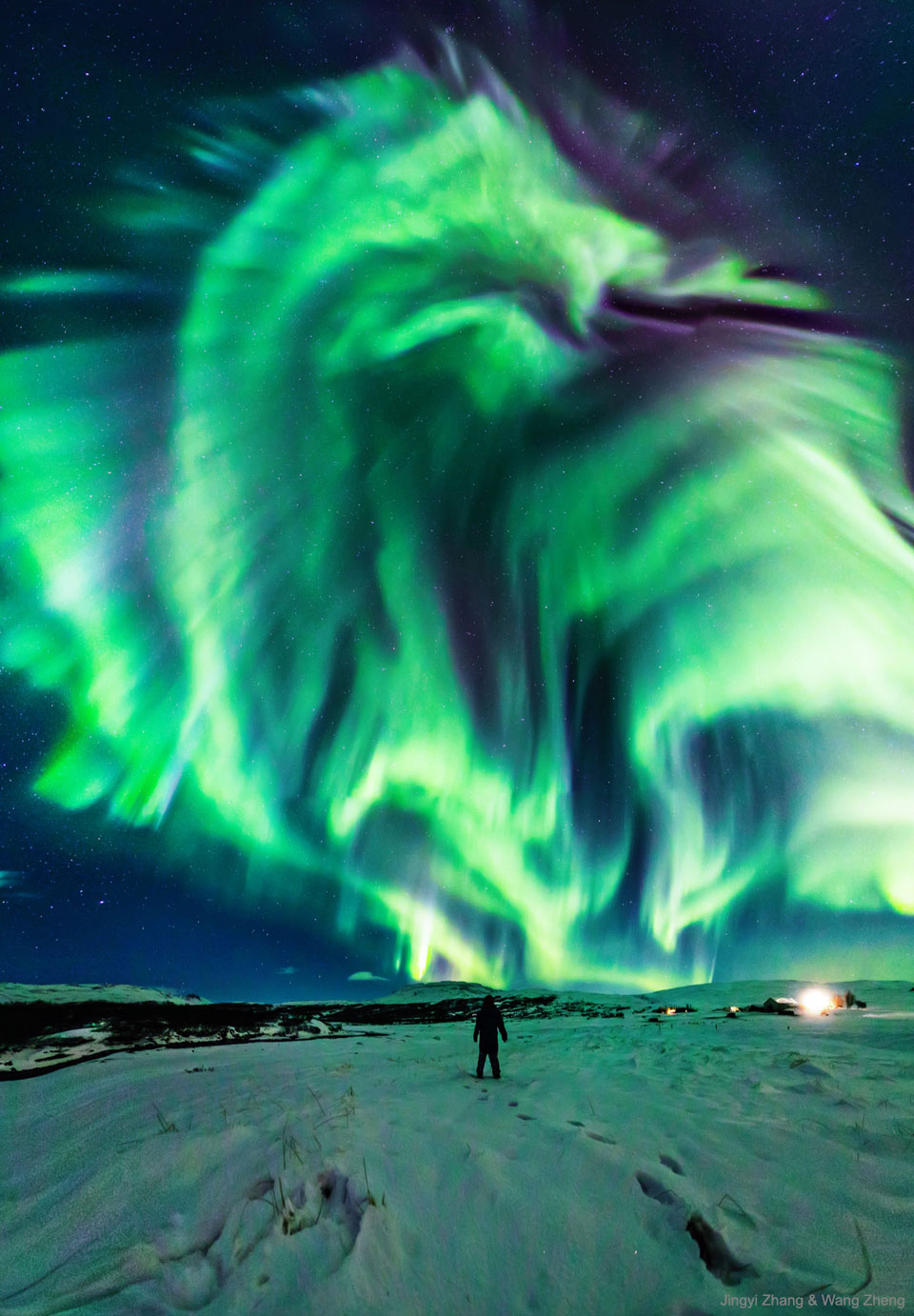
Have you ever seen a dragon in the sky? Although real flying dragons don't exist, a huge dragon-shaped aurora developed in the sky over Iceland in 2019. The aurora was caused by a hole in the Sun's corona that expelled charged particles into a solar wind that followed a changing interplanetary magnetic field to Earth's magnetosphere. As some of those particles then struck Earth's atmosphere, they excited atoms which subsequently emitted light: aurora. This iconic display was so enthralling that the photographer's mother ran out to see it and was captured in the foreground. Our active Sun continues to show an unusually high number of prominences, filaments, sunspots, and large active regions as solar maximum approaches in 2025.