The Sun
The Sun is a yellow dwarf star (G2V), about 4.6 billion years old, and the dominant gravitational force in the Solar System. It has a diameter of roughly 1.4 million kilometers and contains around 99.8% of the Solar System’s mass. Nuclear fusion in its core converts hydrogen into helium, producing energy that warms the planets. Above the core lie the radiative and convective zones, followed by the visible photosphere (~5,500 °C), the chromosphere, and the much hotter corona (~2 million °C).
Source: science.nasa.gov
APODs including "The Sun"
Shadows of Mountain and Moon
22/01/2024
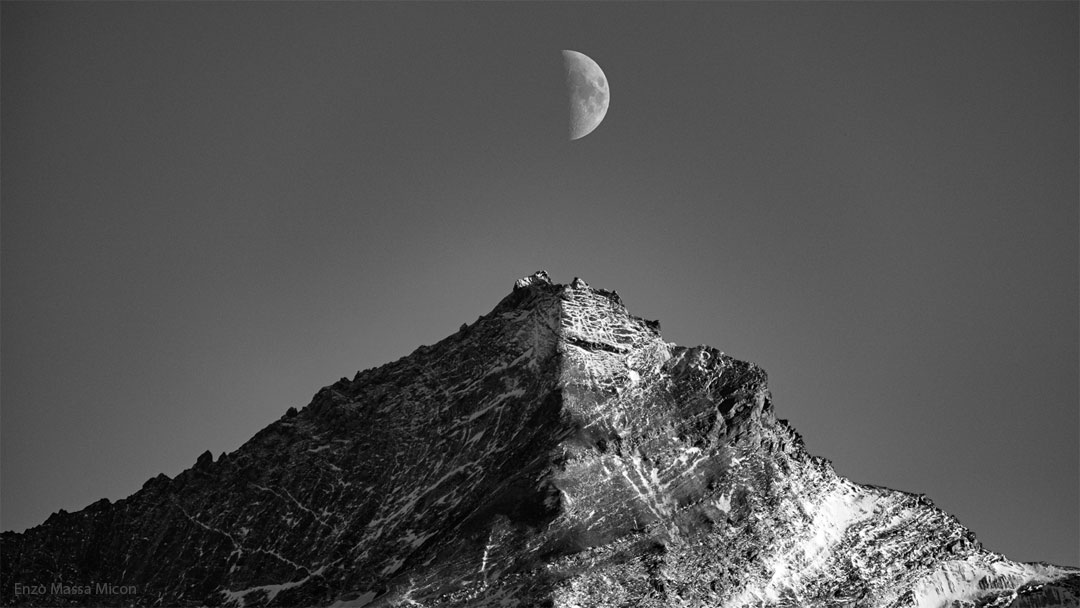
Can the Moon and a mountain really cast similar shadows? Yes, but the division between light and dark does not have to be aligned. Pictured, a quarter moon was captured above the mountain Grivola in Italy in early October of 2022. The Sun is to the right of the featured picturesque landscape, illuminating the right side of the Moon in a similar way that it illuminates the right side of the mountain. This lunar phase is called "quarter", in part, because the lit fraction visible from Earth is one quarter of the entire lunar surface. Digital post-processing of this single exposure gave both gigantic objects more prominence. Capturing the terminator of this quarter moon in close alignment with nearly vertical mountain ridge required careful timing because the Earth rotates once a day.