The Sun
The Sun is a yellow dwarf star (G2V), about 4.6 billion years old, and the dominant gravitational force in the Solar System. It has a diameter of roughly 1.4 million kilometers and contains around 99.8% of the Solar System’s mass. Nuclear fusion in its core converts hydrogen into helium, producing energy that warms the planets. Above the core lie the radiative and convective zones, followed by the visible photosphere (~5,500 °C), the chromosphere, and the much hotter corona (~2 million °C).
Source: science.nasa.gov
APODs including "The Sun"
Epsilon Tauri: Star with Planet
26/01/2024
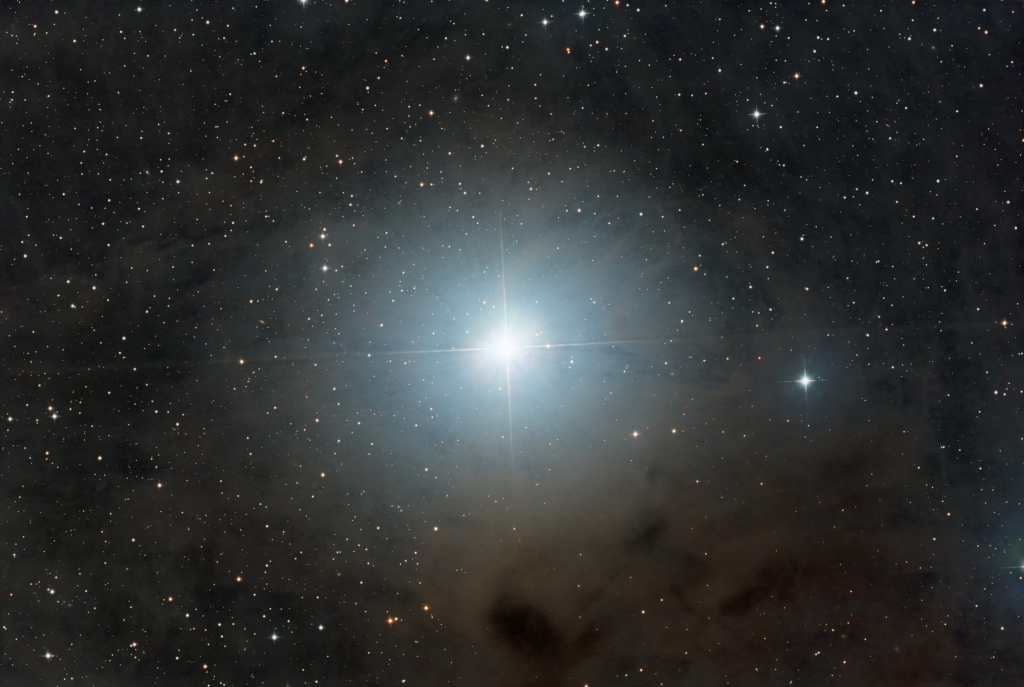
silon Tauri lies 146 light-years away. A K-type red giant star, epsilon Tau is cooler than the Sun, but with about 13 times the solar radius it shines with nearly 100 times the solar luminosity. A member of the Hyades open star cluster the giant star is known by the proper name Ain, and along with brighter giant star Aldebaran, forms the eyes of Taurus the Bull. Surrounded by dusty, dark clouds in Taurus, epsilon Tau is also known to have a planet. Discovered by radial velocity measurements in 2006, epsilon Tauri b is a gas giant planet larger than Jupiter with an orbital period of 1.6 years. And though the exoplanet can't be seen directly, on a dark night its parent star epsilon Tauri is easily visible to the unaided eye.