The Sun
The Sun is a yellow dwarf star (G2V), about 4.6 billion years old, and the dominant gravitational force in the Solar System. It has a diameter of roughly 1.4 million kilometers and contains around 99.8% of the Solar System’s mass. Nuclear fusion in its core converts hydrogen into helium, producing energy that warms the planets. Above the core lie the radiative and convective zones, followed by the visible photosphere (~5,500 °C), the chromosphere, and the much hotter corona (~2 million °C).
Source: science.nasa.gov
APODs including "The Sun"
Moon Pi and Mountain Shadow
14/03/2024
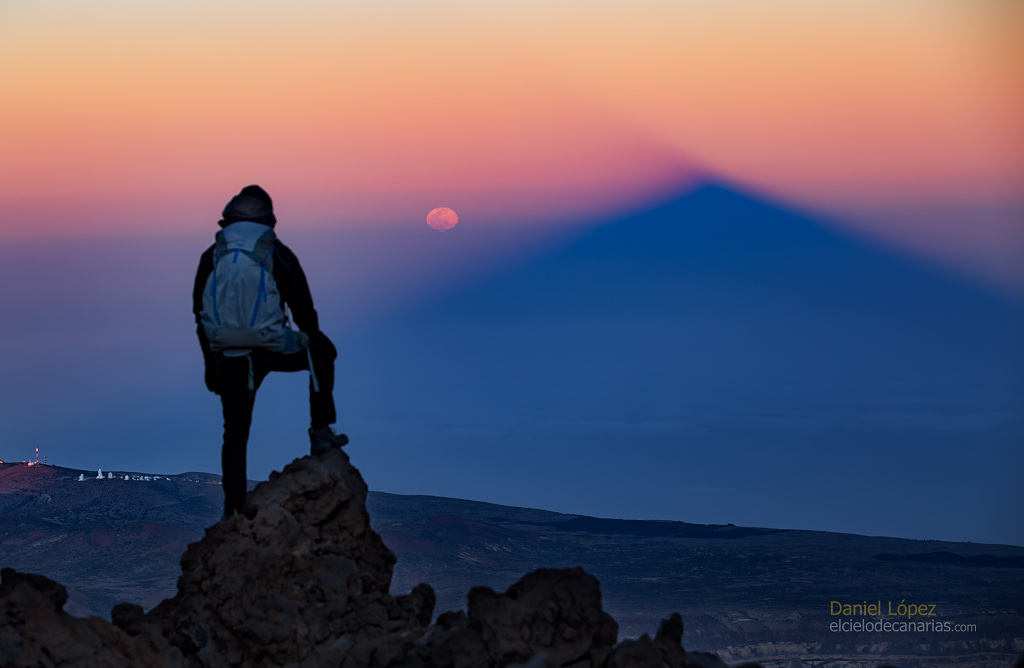
What phase of the Moon is 3.14 radians from the Sun? The Full Moon, of course. Even though the Moon might look full for several days, the Moon is truly at its full phase when it is Pi radians (aka 180 degrees) from the Sun in ecliptic longitude. That's opposite the Sun in planet Earth's sky. Rising as the Sun set on March 9, 2020, only an hour or so after the moment of its full phase, this orange tinted and slightly flattened Moon still looked full. It was photographed opposite the setting Sun from Teide National Park on the Canary Island of Tenerife. Also opposite the setting Sun, seen from near the Teide volcano peak about 3,500 meters above sea level, is the mountain's rising triangular shadow extending into Earth's dense atmosphere. Below the distant ridge line on the left are the white telescope domes of Teide Observatory. Again Pi radians from the Sun, on March 25 the Full Moon will dim slightly as it glides through Earth's outer shadow in a penumbral lunar eclipse.