The Sun
The Sun is a yellow dwarf star (G2V), about 4.6 billion years old, and the dominant gravitational force in the Solar System. It has a diameter of roughly 1.4 million kilometers and contains around 99.8% of the Solar System’s mass. Nuclear fusion in its core converts hydrogen into helium, producing energy that warms the planets. Above the core lie the radiative and convective zones, followed by the visible photosphere (~5,500 °C), the chromosphere, and the much hotter corona (~2 million °C).
Source: science.nasa.gov
APODs including "The Sun"
A Picturesque Equinox Sunset
19/03/2024
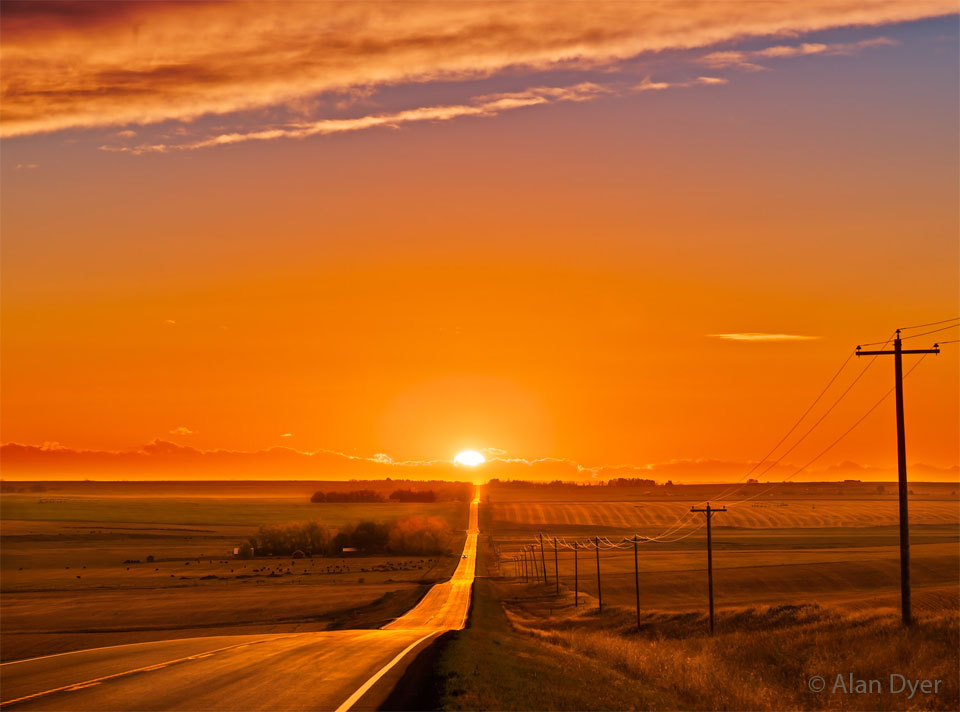
What's that at the end of the road? The Sun. Many towns have roads that run east-west, and on two days each year, the Sun rises and sets right down the middle. Today, in some parts of the world (tomorrow in others), is one of those days: an equinox. Not only is this a day of equal night ("aequus"-"nox") and day time, but also a day when the sun rises precisely to the east and sets due west. Displayed here is a picturesque rural road in Alberta, Canada that runs approximately east-west. The featured image was taken during the September Equinox of 2021, but the geometry remains the same every year. In many cultures, this March equinox is taken to be the first day of a season, typically spring in Earth's northern hemisphere, and autumn in the south. Does your favorite street run east-west? Tonight, at sunset, you can find out with a quick glance.