The Sun
The Sun is a yellow dwarf star (G2V), about 4.6 billion years old, and the dominant gravitational force in the Solar System. It has a diameter of roughly 1.4 million kilometers and contains around 99.8% of the Solar System’s mass. Nuclear fusion in its core converts hydrogen into helium, producing energy that warms the planets. Above the core lie the radiative and convective zones, followed by the visible photosphere (~5,500 °C), the chromosphere, and the much hotter corona (~2 million °C).
Source: science.nasa.gov
APODs including "The Sun"
The Changing Ion Tail of Comet Pons-Brooks
08/04/2024
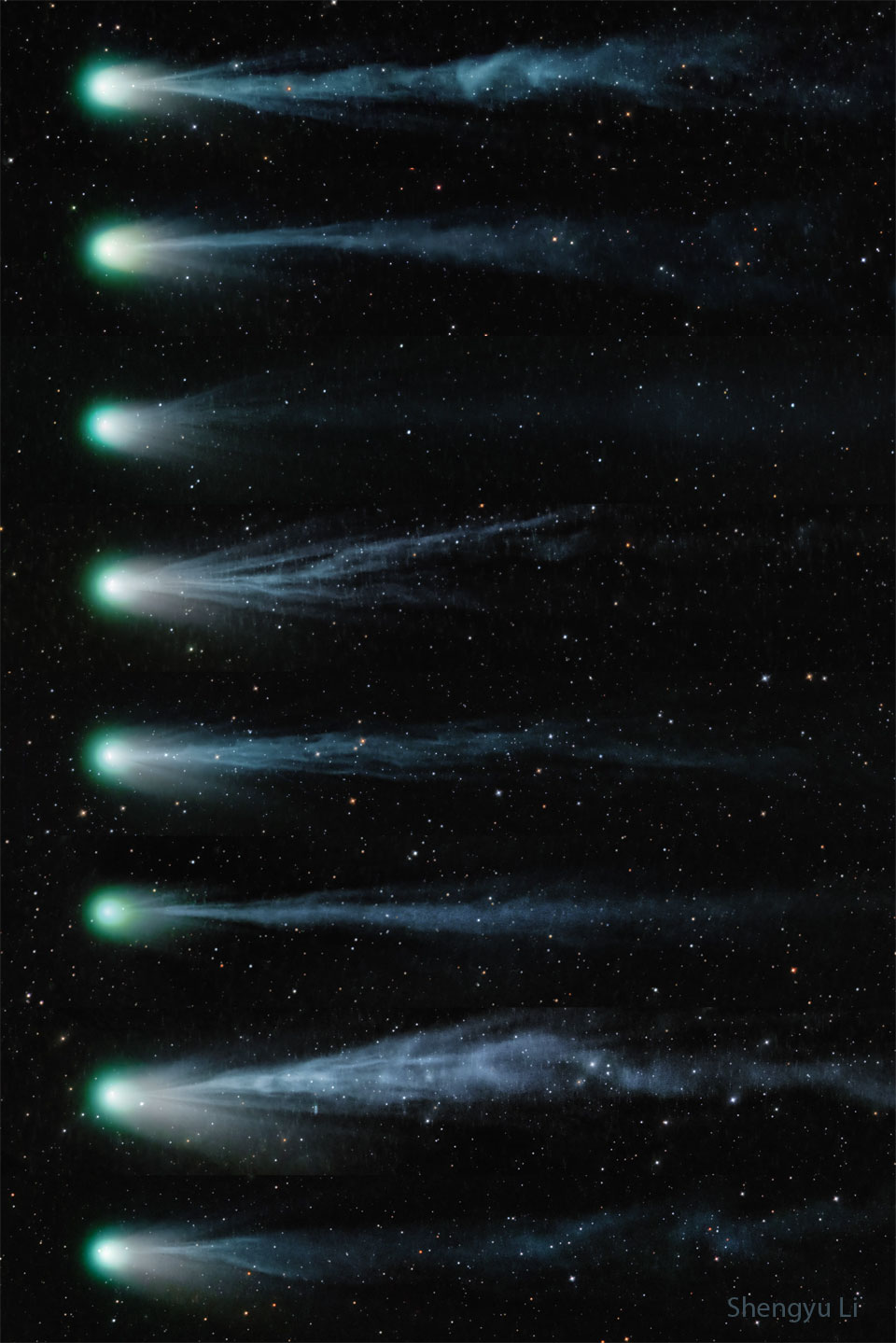
How does a comet tail change? It depends on the comet. The ion tail of Comet 12P/Pons–Brooks has been changing markedly, as detailed in the featured image sequenced over nine days from March 6 to 14 (top to bottom). On some days, the comet's ion tail was relatively long and complex, but not every day. Reasons for tail changes include the rate of ejection of material from the comet's nucleus, the strength and complexity of the passing solar wind, and the rotation rate of the comet. Over the course of a week, apparent changes even include a change of perspective from the Earth. In general, a comet's ion tail will point away from the Sun, as gas expelled is pushed out by the Sun's wind. Today, Pons-Brooks may become a rare comet suddenly visible in the middle of the day for those able to see the Sun totally eclipsed by the Moon. NASA Coverage: Today's Total Solar Eclipse Total Eclipse Imagery: Notable Submissions to APOD